
The G7 Just Made AI a Summit Item: What the Evian Working Lunch and the SK Telecom Trigger Mean for Every Enterprise Leader
On June 17, 2026, the G7 summit in Evian-les-Bains closed with what the French presidency described as a dedicated working lunch between G7 political leaders and a selected group of technology executives — including Dario Amodei of Anthropic, Sam Altman of OpenAI, and Google DeepMind representatives — to discuss ensuring safe, rapid and effective AI deployment. It was the first time in G7 history that AI received its own standing agenda item with direct CEO participation rather than being a sub-topic of the broader technology discussion. The same day, WIRED published the most complete account of what actually triggered the Fable 5 government shutdown five days earlier — and the answer is not a universal jailbreak. It is a single organisation: SK Telecom, a $100 million Anthropic investor and Project Glasswing partner, which the White House identified as having suspected ties to China, leading to a cascade of events that shut down Anthropic's most capable models for all customers worldwide. Both stories — the G7 working lunch and the SK Telecom trigger — are fundamentally the same story: AI governance has left the technology industry and entered the room where heads of state make decisions.
Date
Jun 17, 2026
Category
INDUSTRY
Reading Time
7 MINUTES
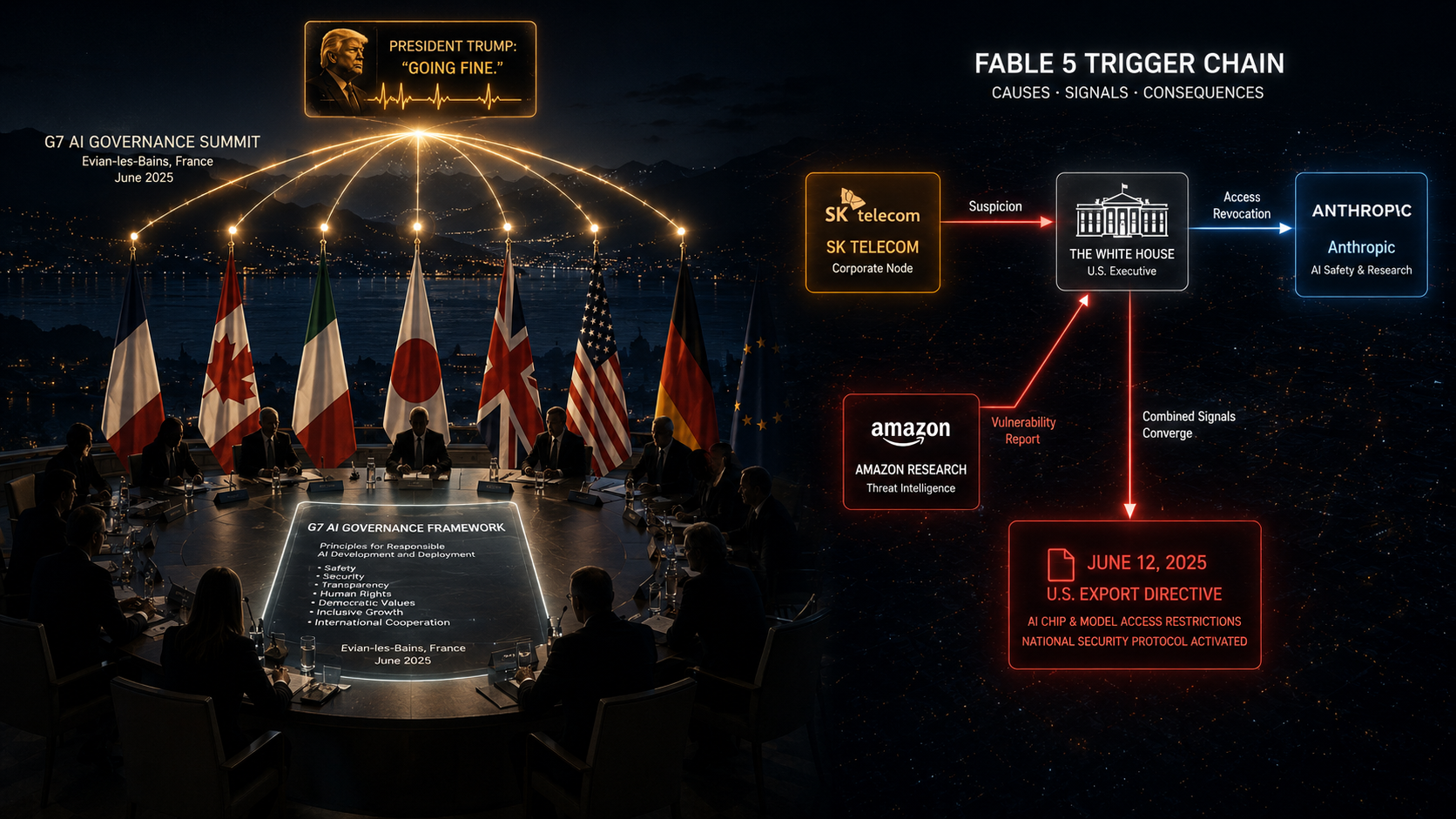
The G7 summit in Evian-les-Bains closed on June 17, 2026 with what the French presidency described as a dedicated AI working lunch between G7 political leaders and a selected group of technology executives — including Anthropic CEO Dario Amodei, OpenAI CEO Sam Altman and representatives from Google DeepMind — to discuss ensuring safe, rapid and effective AI deployment. The working lunch format — heads of state and AI lab CEOs at the same table, specifically convened around AI — is a political signal that belongs in every enterprise AI governance discussion. The technology that enterprise organisations are deploying in production workflows, customer communication and financial decision-making has reached the level of international political attention that historically preceded the most consequential regulatory shifts in enterprise technology history.
President Trump said from the G7 that negotiations around the Fable 5 export control directive were "going fine." Anthropic's Managing Director of International Chris Ciauri said at the Seoul press conference on June 17-18 that he was "very confident" the models would return "within days." No official restoration date has been confirmed as of June 17.
The WIRED account of the Fable 5 trigger, published June 17, is the most important piece of context for understanding the government-Anthropic conflict and its enterprise implications. The White House identified SK Telecom — South Korea's largest carrier, a $100 million Anthropic investor since 2023, and a Project Glasswing partner — as a company suspected of having ties to China among the approximately 150 organisations granted Mythos access. The administration asked Anthropic to revoke only SK Telecom's access, which Anthropic immediately did. Separately, Amazon researchers then identified potential vulnerabilities in Fable 5 and reported them to the White House. The combined sequence — SK Telecom access revocation plus the Amazon vulnerability report — led the administration to conclude it could not trust Anthropic to safeguard its most advanced AI technology, triggering the broader export control directive.
David Sacks, co-chair of the President's Council of Advisers on Science and Technology, revealed on June 13 that the Trump administration offered Anthropic a choice before issuing the export control ban: Anthropic could either fix the identified jailbreak in Fable 5, or voluntarily de-deploy the model. Anthropic's refusal to voluntarily de-deploy — combined with its technical assessment that the vulnerability did not represent a meaningful capability advance beyond what other public models already offered — produced the export control directive that shut the model down for all customers.
The SK Telecom dimension of the story is the one that most directly affects enterprise AI vendor risk assessment. SK Telecom is not a marginal partner — it is a $100 million strategic investor in Anthropic and a member of Project Glasswing, the AI cybersecurity coalition we covered in April. The White House's designation of SK Telecom as a suspected China-linked entity while it was a Glasswing partner produced the chain of events that led to the export control directive. For enterprise AI procurement teams, the implication is specific: an AI vendor's strategic partnerships — investors, compute partners, research collaborators — are inputs to that vendor's regulatory risk profile, not just to its financial profile. When SK Telecom's relationship with Anthropic became the trigger for a government directive, it affected every Anthropic customer globally, not just SK Telecom.
The G7 working lunch is the political context within which the resolution of the Fable 5 situation is most likely to occur. When the leaders of seven major economies convene specifically to discuss AI deployment with the CEOs of the companies affected by export control disputes, the diplomatic signals are clear. President Trump's "going fine" characterisation of negotiations from the G7 setting suggests the resolution is proceeding within a diplomatic framework that extends beyond the bilateral Anthropic-Commerce Department relationship. The presence of Amodei and Altman at the same G7 table — at the same time that both companies are in IPO processes dependent on investor confidence — provides additional incentive for all parties to find a resolution that restores access before the financial market windows that matter most to both companies.
The G7 AI governance dimension goes substantially beyond the Fable 5 situation. The working lunch produced what French diplomatic readouts described as consensus on three principles: that AI deployment should be accelerated for economic competitiveness, that safety and governance frameworks should not prevent responsible deployment, and that international AI governance coordination should be prioritised over unilateral national restrictions where possible. The third principle is the most consequential for the Fable 5 resolution — and for every future enterprise AI vendor risk scenario. A G7 consensus that international coordination should be prioritised over unilateral restrictions creates political pressure against exactly the kind of single-country export control directive that produced the June 12 shutdown.
For enterprise technology leaders watching the AI governance trajectory, the G7 working lunch is the moment that confirms AI model regulation has entered the diplomatic tier. The export control directives, the state legislation, the EU AI Act and the Great American AI Act we have been covering throughout this year are now accompanied by a multilateral diplomatic framework that the world's most powerful economies are building in parallel. The enterprises that track that diplomatic framework — and its implications for the availability, pricing and governance requirements of frontier AI models — will make more accurate long-term AI platform decisions than those who treat regulation as a purely domestic compliance concern.
At Legacies Techno, the G7 working lunch and the SK Telecom trigger have two specific implications for our client engagements. Our AI-Powered Platforms practice is updating its vendor risk assessment templates to include strategic partner due diligence as a standard input — specifically, evaluating which governments have raised concerns about which of a vendor's investors, research partners or compute supply relationships. The SK Telecom trigger demonstrates that a vendor's partner relationships are a material input to the regulatory risk profile of that vendor's most advanced models.
Our Enterprise Software Development practice is specifically noting the Amazon vulnerability disclosure dimension of the Fable 5 trigger. Amazon researchers identified potential vulnerabilities in Fable 5 and reported them to the White House, contributing to the chain of events that produced the export directive. Amazon is also AWS, which hosts Bedrock and which Anthropic has made one of its primary distribution partners. The fact that Amazon's researchers contributed to the government action against Anthropic's model while AWS hosts Anthropic's commercial API access is the kind of complex multi-party relationship dynamic that enterprise vendor risk assessment frameworks were not designed for and must now accommodate.
The week that began with the SpaceX SPCX IPO ended with a G7 working lunch on AI governance. Enterprise AI has arrived at the intersection of capital markets, geopolitics and technology regulation simultaneously. The organisations that understand all three dimensions — not just the technology — will navigate what comes next from a position of clarity rather than surprise.
Key Highlights
- The G7 summit in Evian-les-Bains closed June 17 with a dedicated AI working lunch between G7 political leaders and technology CEOs including Anthropic's Dario Amodei and OpenAI's Sam Altman — the first time AI has received its own standing G7 working group agenda item with direct CEO participation.
- WIRED published the most complete account of the Fable 5 trigger on June 17: the White House identified SK Telecom — a $100 million Anthropic investor and Project Glasswing partner — as suspected of having ties to China; Anthropic revoked SK Telecom's Mythos access; Amazon researchers separately identified vulnerabilities in Fable 5 and reported them to the White House; the combined sequence led the administration to conclude it could not trust Anthropic to safeguard advanced AI technology.
- David Sacks (PCAST co-chair) revealed on June 13 that the administration offered Anthropic a choice before issuing the directive: fix the jailbreak or voluntarily de-deploy. Anthropic declined to voluntarily de-deploy, assessing that the demonstrated vulnerability was no more capable than other publicly available models.
- President Trump said at the G7 that Fable 5 negotiations were "going fine." Anthropic's Chris Ciauri said at the Seoul press conference that he was "very confident" access would be restored "within days." No official restoration date has been announced as of June 17.
- The G7 AI working lunch produced diplomatic consensus on three principles: accelerating AI deployment for economic competitiveness, ensuring safety frameworks do not prevent responsible deployment, and prioritising international coordination over unilateral national restrictions — the third principle having direct implications for the export control approach that produced the Fable 5 shutdown.
- SK Telecom denies any ties to China. The White House's designation of a strategic Anthropic investor as a suspected China-linked entity demonstrates that AI vendor partner relationships are inputs to regulatory risk profiles in ways that enterprise procurement frameworks have not previously accommodated.
- The Amazon dimension — Amazon researchers contributing to the government action against Anthropic's model while AWS is a primary Anthropic commercial distribution partner — represents a new class of multi-party relationship complexity that requires enterprise vendor risk frameworks to evolve.
- The G7 working lunch marks the moment AI model governance officially entered the multilateral diplomatic tier — joining the set of international coordination challenges that heads of state manage alongside trade, security and monetary policy.
Why This Matters
- The G7 working lunch is not a symbolic event. When the leaders of the G7 nations convene with AI lab CEOs at the same table as a formal summit agenda item, the governance decisions that emerge from those conversations carry the same diplomatic weight as trade agreements, financial regulations and security commitments. The three principles that emerged — accelerate deployment, ensure safety frameworks are proportionate, prioritise international coordination — are the framework that will shape the next generation of national AI regulatory decisions. Enterprises that track multilateral AI governance alongside national regulatory developments will anticipate regulatory shifts rather than reacting to them.
- The SK Telecom trigger reveals that enterprise AI vendor risk assessment must include strategic partner due diligence at a depth that most procurement frameworks have not previously required. An Anthropic investor's suspected government relationship produced a government directive that shut down Anthropic's most advanced models globally. The chain of causation from "vendor investor flagged by government" to "all vendor customers globally experience outage" is the enterprise risk scenario that requires explicit analysis. Identifying which of a vendor's investors, compute partners and research collaborators have government relationships that could create similar chains of causation is the due diligence expansion that the SK Telecom trigger makes necessary.
- The Trump "going fine" characterisation and the Ciauri "within days" confidence signal together provide the most specific timeline indication available that Fable 5 access will be restored in the near term. Enterprises that disrupted planned Fable 5 deployments following the June 12 shutdown should begin the validation and integration planning work now, with the expectation that access restoration will create a narrow window before the model's capabilities are again actively deployed by competitors who have maintained their integration planning during the shutdown period.
- The Amazon-Anthropic complexity is the multi-party relationship dynamic that most enterprise procurement assessments will need to add as an explicit risk category. When a company is simultaneously a commercial distribution partner (AWS) and a source of technical vulnerability disclosures that contributed to a government directive against the vendor's most advanced model (Amazon Research), the enterprise risk assessment of that vendor must account for the full range of relationships between the vendor, its distributors and the government entities those distributors interact with.
Author
Sathyamurthy Tiroumourty
RELATED NEWS
SEE ALLSEE ALL
CONTACT
LET'S ENGINEER THE FUTURE — TOGETHER
.png)
.
.
/
.png)
Whether you're scaling a digital product, modernizing operations, or building from the ground up — Legacies Techno is your partner in crafting intelligent, enterprise-grade solutions that create lasting impact.
GET IN TOUCHGET IN TOUCH