
The Second AI Infrastructure Race: What China's $295 Billion State Plan Means for Every Enterprise in the Global AI Market
China's National Development and Reform Commission is drafting a plan to invest 2 trillion yuan — approximately $295 billion — over five years to build a nationwide network of interconnected AI data centres operated by China Mobile and China Telecom, supplied by domestic chipmakers including Huawei, and designed to rely on at least 80 percent domestic AI silicon. The plan, reported by Bloomberg on June 9 and confirmed by subsequent Chinese government statements, represents the most coordinated state investment in AI infrastructure anywhere in the world. It is being finalised as the US private sector is committing $725 billion to AI infrastructure in 2026 alone. The two investment programmes share the same objective — ensuring national AI capability leadership — and are built on fundamentally different architectures: US private-sector capital flowing through hyperscalers and neocloud operators into NVIDIA GPU infrastructure, versus Chinese state capital flowing through state telecoms into Huawei Ascend infrastructure. For every enterprise operating in both markets, the implications are specific, structural and affecting procurement decisions today.
Date
Jun 22, 2026
Category
INDUSTRY
Reading Time
7 MINUTES
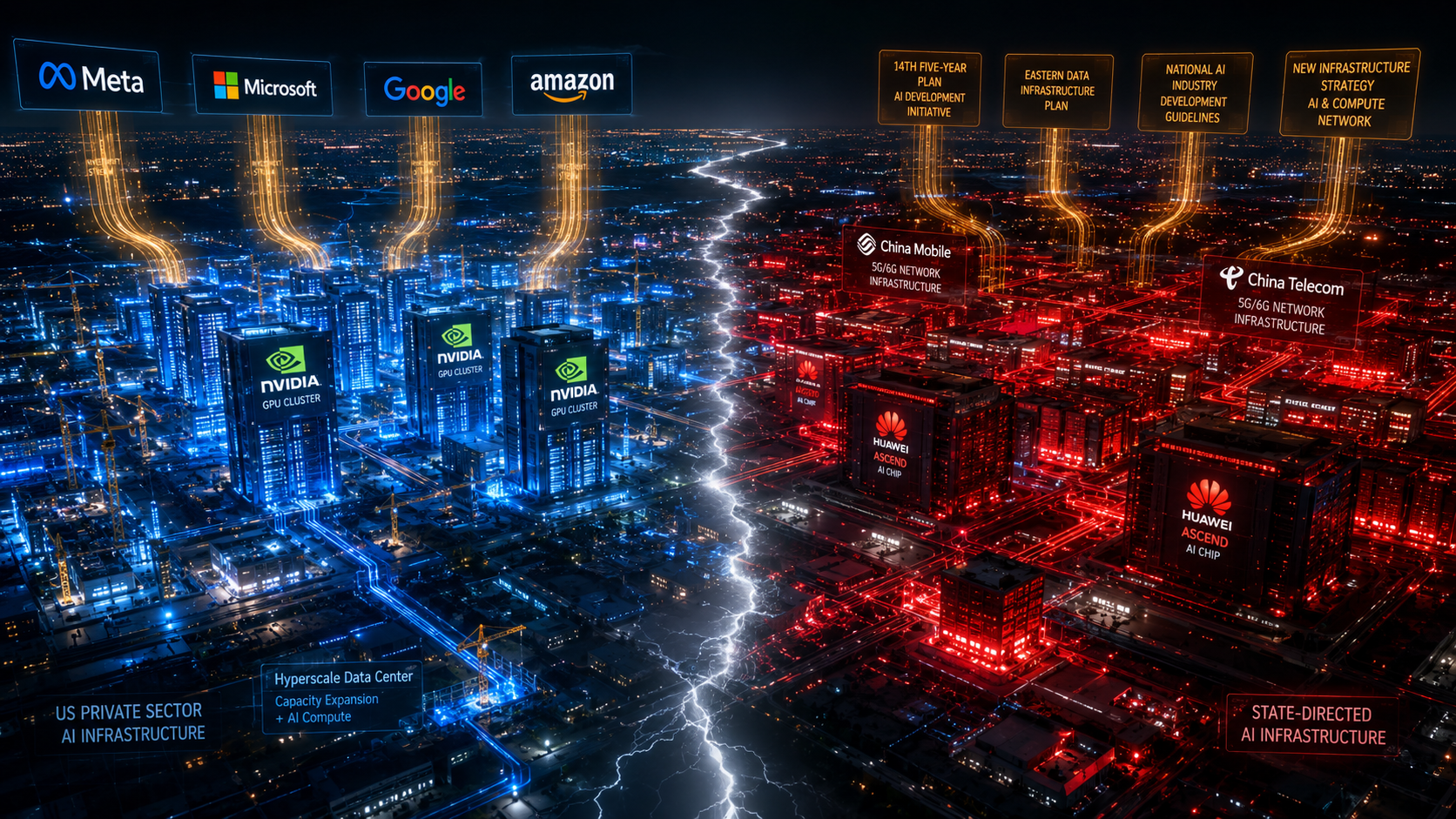
China is preparing to spend around 2 trillion yuan ($295 billion) over the next five years on building data centres across the country, fuelling Beijing's ambition to propel the domestic AI sector and surpass the US in a potentially game-changing technology. Key government agencies including the National Development and Reform Commission are drafting a blueprint to erect a network of interconnected computing hubs. State firms such as China Mobile and China Telecom will operate the bulk of the data centres and ensure they are connected. The plan is to rely on local suppliers, including Huawei Technologies, for at least 80 percent of technology such as AI chips, effectively squeezing out NVIDIA and AMD.
The scale framing that puts $295 billion in context is essential. The $295 billion five-year total compares to the $725 billion that US companies including Meta and Microsoft are setting aside for AI investment in 2026 alone. Chinese data centres generally cost less to build and operate than their US equivalents because of lower labour, component and construction costs and local government incentives. The comparison — $295 billion over five years (Chinese state) versus $725 billion in a single year (US private sector) — should not be read as a straightforward US advantage. State investment in China historically moves with different efficiency and focus characteristics than private market investment. The US private sector is building general-purpose hyperscaler infrastructure optimised for multiple commercial use cases. China's state plan is building infrastructure optimised for a specific strategic objective: ensuring that China has sovereign AI compute that cannot be shut off by US export controls.
The export control context is the most important dimension of the Chinese plan for enterprise technology leaders to understand. Washington has agreed to allow NVIDIA to sell its previous-generation H200 AI chips to Chinese customers — a significant easing of measures aimed at restraining China's AI development. But shipments have yet to begin, in a sign that Beijing is growing increasingly confident in replacing some AI computing capacity with locally made hardware. In May, nine types of homegrown AI chips including from Huawei, Alibaba, Shanghai Biren Technology Co and Moore Threads Technology Co passed a security review by a Chinese technology security agency, opening the door to their wider deployment.
Beijing has massively tightened its restrictions on foreign silicon in a series of new controls. Last August, Beijing introduced a requirement that data centres source at least 50 percent of chips locally, and by November, state-funded projects were barred from foreign accelerators entirely. Builds less than 30 percent complete were reportedly told to strip out NVIDIA, AMD and Intel parts.
The domestic chip supply chain reality that sits beneath the ambition of the $295 billion plan is the dimension that Tom's Hardware's analysis makes most clear. Chinese chip industry leaders admit the country lags five to ten years behind in AI data centre chips. When DeepSeek was steered toward Huawei hardware for model training, it eventually reverted to NVIDIA hardware, lending credence to the idea that domestic parts still struggle with the heaviest training workloads, even where they suffice for inference. SMIC co-CEO Zhao Haijun has cautioned that the rush to add capacity risks leaving data centres idle, comparing it to building highways ahead of the traffic. Analysts estimate China's domestic suppliers will cover only around 76 percent of all Chinese AI chip demand by 2030.
The honest enterprise picture of China's AI infrastructure plan is therefore a two-level reality. At the strategic level, the plan is the most significant state commitment to AI infrastructure sovereignty in history — the kind of multi-decade, mission-driven investment that China has successfully deployed in manufacturing, solar energy and telecommunications to establish global leadership positions from trailing positions. At the operational level, the plan's success depends on Huawei Ascend production scaling in ways that the supply chain has not yet demonstrated, and on domestic model training achieving parity with NVIDIA-GPU-trained models in ways that DeepSeek's temporary Huawei hardware reversion suggests has not yet been achieved.
For global enterprises, the Chinese plan produces three specific strategic implications. The first is AI infrastructure bifurcation. The plan's design — 80 percent domestic silicon, operated by state telecoms, with rules preventing foreign silicon in new state-funded projects — is a deliberate architectural decoupling from the NVIDIA-centred global AI infrastructure. By 2028, when the plan targets cohesive national network completion, China will have a sovereign AI compute environment that operates on different hardware, different model families and different regulatory architecture from the US-centred global infrastructure. Enterprises with significant Chinese market operations need to plan their AI infrastructure for both compute environments independently, because the tools, models and governance frameworks that work in the US-centred environment may not transfer to the China sovereign environment.
The second implication is Chinese open-weight model trajectory. The four Chinese open-weight models we covered in May — GLM-5.1, Kimi K2.6, MiniMax M2.7 and DeepSeek V4 — were produced by companies operating under the current, constrained Chinese compute environment. The $295 billion state compute infrastructure, when operational, provides the training compute that could produce Chinese open-weight models at capability levels that more closely approach the US frontier. Chinese models trained on Huawei Ascend at data centre scale — rather than the smaller distributed GPU clusters that most current Chinese labs use — may produce capability advances that change the enterprise model cost-capability tradeoff that those four models established in April. Enterprise AI architects should model a trajectory where Chinese open-weight models improve significantly in the 2028-2030 window as the state compute infrastructure becomes operational.
The third implication is procurement and vendor landscape for China-operating enterprises. The Chinese domestic AI chip approval in May — nine chip families from Huawei, Alibaba, Biren and Moore Threads — establishes the hardware ecosystem that enterprises deploying AI in China will need to support. The 80 percent domestic silicon requirement for state-funded projects is the regulatory floor, not the ceiling. As China's government increasingly applies digital sovereignty requirements to enterprise AI deployments that touch state functions, regulated industries or sensitive data, the procurement landscape for AI hardware in China will diverge from the NVIDIA-centred global landscape with increasing speed.
At Legacies Techno, China's $295 billion AI infrastructure plan affects three dimensions of our strategic advisory work. Our AI-Powered Platforms practice designs for clients with China market exposure with the expectation that China AI deployment will require a separate model and infrastructure architecture from their US-market deployment. The model routing logic, the governance documentation requirements and the compute infrastructure dependencies are sufficiently different between the two markets that a unified global AI platform architecture is increasingly impractical for large enterprises with meaningful Chinese operations. Separate but connected architectures — sharing governance frameworks and model orchestration principles while adapting to local compute and regulatory requirements — are the design pattern we recommend.
Our Enterprise Software Development practice is specifically tracking the Huawei Ascend 950 production ramp as the leading indicator of when the Chinese state compute infrastructure will reach the training workload performance level required to close the gap between Chinese and US frontier models on the heaviest tasks. The Ascend 950 is the chip that the $295 billion plan depends on for training-class workloads. Its production ramp, supply chain sustainability and real-world performance on large model training will be the empirical test of whether the plan's strategic objectives are achievable within its 2028 timeline.
Our Smart Automation practice designs automation workflows for clients with China market exposure using Chinese-available model alternatives — DeepSeek V4, Kimi K2.6, GLM-5.1 — that can operate within the domestic compute environment that China's regulatory architecture is increasingly requiring. The automation capability these models provide at the current state of Chinese AI infrastructure is substantial for inference-class workloads, even if training-class parity remains aspirational.
The second AI infrastructure race is not a mirror image of the first. It is a structurally different investment — state-directed versus market-driven, sovereignty-optimised versus efficiency-optimised, domestic silicon versus NVIDIA silicon. Both are building toward the same objective: AI capability at national scale. The enterprises that understand the structural differences between the two infrastructure environments will make better China-market AI decisions than those that assume the global AI infrastructure is a unified whole.
It is not. And it is becoming less so by the quarter.
Key Highlights
- China's National Development and Reform Commission is drafting a plan to invest 2 trillion yuan ($295 billion) over five years to build a nationwide AI data centre network operated by China Mobile and China Telecom, relying on at least 80 percent domestic AI silicon — effectively squeezing out NVIDIA and AMD. The plan is part of China's "Six Networks" strategic infrastructure programme.
- The $295 billion five-year total compares to $725 billion that US private-sector companies are investing in AI infrastructure in 2026 alone. Chinese data centres cost less to build due to lower labour, component and construction costs — the spending comparison is not linear.
- In November 2025, Beijing barred state-funded projects from foreign accelerators entirely and required data centres to source at least 50 percent of chips locally. In May 2026, nine domestic AI chip families (Huawei, Alibaba, Biren, Moore Threads) passed the Chinese government security review for wider deployment.
- The plan's operational foundation depends on Huawei Ascend scaling at training workload levels that domestic chips have not yet demonstrated. DeepSeek reportedly reverted from Huawei hardware to NVIDIA hardware for heavy training workloads. Chinese chip executives have acknowledged the country lags five to ten years behind the leading edge in AI data centre silicon.
- The plan's 2028 completion timeline for a cohesive national compute network — if achieved — would give China a sovereign AI compute environment entirely decoupled from US export control reach, operating on different hardware, different model families and different regulatory architecture.
- Nine types of homegrown AI chips from Huawei, Alibaba, Shanghai Biren Technology and Moore Threads Technology passed Chinese government security review in May 2026, opening the door to wider deployment in government and security-sensitive sectors.
- Washington agreed to allow NVIDIA to sell H200 chips (one generation behind current Blackwell) to Chinese customers — a partial easing of export controls. Shipments have not yet begun, suggesting Beijing is not relying on the easing but is instead continuing its domestic chip development strategy.
- Bloomberg reported the plan could reach 5 trillion yuan if power grid integration is included. Analysts estimate Chinese domestic suppliers will cover approximately 76 percent of Chinese AI chip demand by 2030, even under the accelerated domestic development scenario the plan represents.
Why This Matters
- The AI infrastructure bifurcation between US-private and China-state compute environments is the most significant structural change to the global AI market since the initial US export control restrictions in 2022. Enterprises that have been treating the global AI infrastructure as a unified environment should update that assumption explicitly. By 2028, the compute available in China for AI training and inference will increasingly run on hardware, models and governance frameworks that are structurally separate from the NVIDIA-centred global infrastructure.
- The domestic silicon capability gap between ambition and reality is the variable that most directly determines whether China's $295 billion plan produces the AI capability outcomes Beijing intends on its projected timeline. The Huawei Ascend 950 production ramp is the single most important supply-chain event for China's AI infrastructure plan — and therefore the single most important variable for enterprises planning their China-market AI capabilities for the 2027-2030 window. Tracking Ascend 950 production volumes, yield rates and customer performance benchmarks will be more commercially relevant for China-market planning than any other Chinese AI metric.
- The open-weight model trajectory implication is the most forward-looking enterprise consideration from China's infrastructure plan. DeepSeek V4, Kimi K2.6 and GLM-5.1 were produced under significantly constrained compute. The $295 billion state infrastructure, when operational, provides substantially more training compute for Chinese labs and government-supported model development programmes. The Chinese open-weight models of 2029 may have benchmark profiles substantially different from those of 2026 — and the enterprise cost-capability calculus for routing workloads to Chinese alternatives may shift accordingly.
- The US-China AI governance decoupling that the export control regime and the Chinese state infrastructure plan together represent is the regulatory environment that every multinational enterprise with AI deployments in both markets must now plan for explicitly. The AI models, hardware, governance requirements and regulatory frameworks applicable to AI deployments in the US market are increasingly different from those applicable in China. A single global AI platform architecture that meets the requirements of both markets is becoming less feasible over time. The enterprises that design for regulatory bifurcation now will make the adaptation investments at current cost levels; those that defer will make them at crisis-level cost and urgency.
Author
Sathyamurthy Tiroumourty
RELATED NEWS
SEE ALLSEE ALL
CONTACT
LET'S ENGINEER THE FUTURE — TOGETHER
.png)
.
.
/
.png)
Whether you're scaling a digital product, modernizing operations, or building from the ground up — Legacies Techno is your partner in crafting intelligent, enterprise-grade solutions that create lasting impact.
GET IN TOUCHGET IN TOUCH