
Gemini 3.5 Flash Is Now the Default Everywhere Google Runs AI: What the Rollout Means for Every Enterprise in Google's Ecosystem
On June 18, 2026, Google made Gemini 3.5 Flash the default model across every Gemini-powered product — completing a platform-wide rollout that extended the model's default status from the Gemini app (where it had been the default since Google I/O on May 19) to Gemini Code Assist, Google Workspace AI features in Docs and Gmail, Google AI Studio and the Gemini API default model string. The extension is more consequential than it first appears. Gemini 3.5 Flash scores 76.2 percent on Terminal-Bench 2.1 and 83.6 percent on MCP Atlas, running at approximately four times the speed of competing frontier models — and at $1.50 per million input tokens and $9 per million output tokens, it costs a fraction of what Opus 4.8 or GPT-5.5 charge. For enterprises that have built workflows on Gemini's API using the default model string, the June 18 rollout changed which model their workflows are running without any action required from their engineering teams. And for every enterprise evaluating the current frontier model landscape, the Gemini 3.5 Flash default rollout is the clearest available signal that Google has moved from defending its model capability with flagship models to competing on the efficiency layer where the majority of enterprise AI workload volume actually runs.
Date
Jun 19, 2026
Category
TECHNOLOGY
Reading Time
7 MINUTES
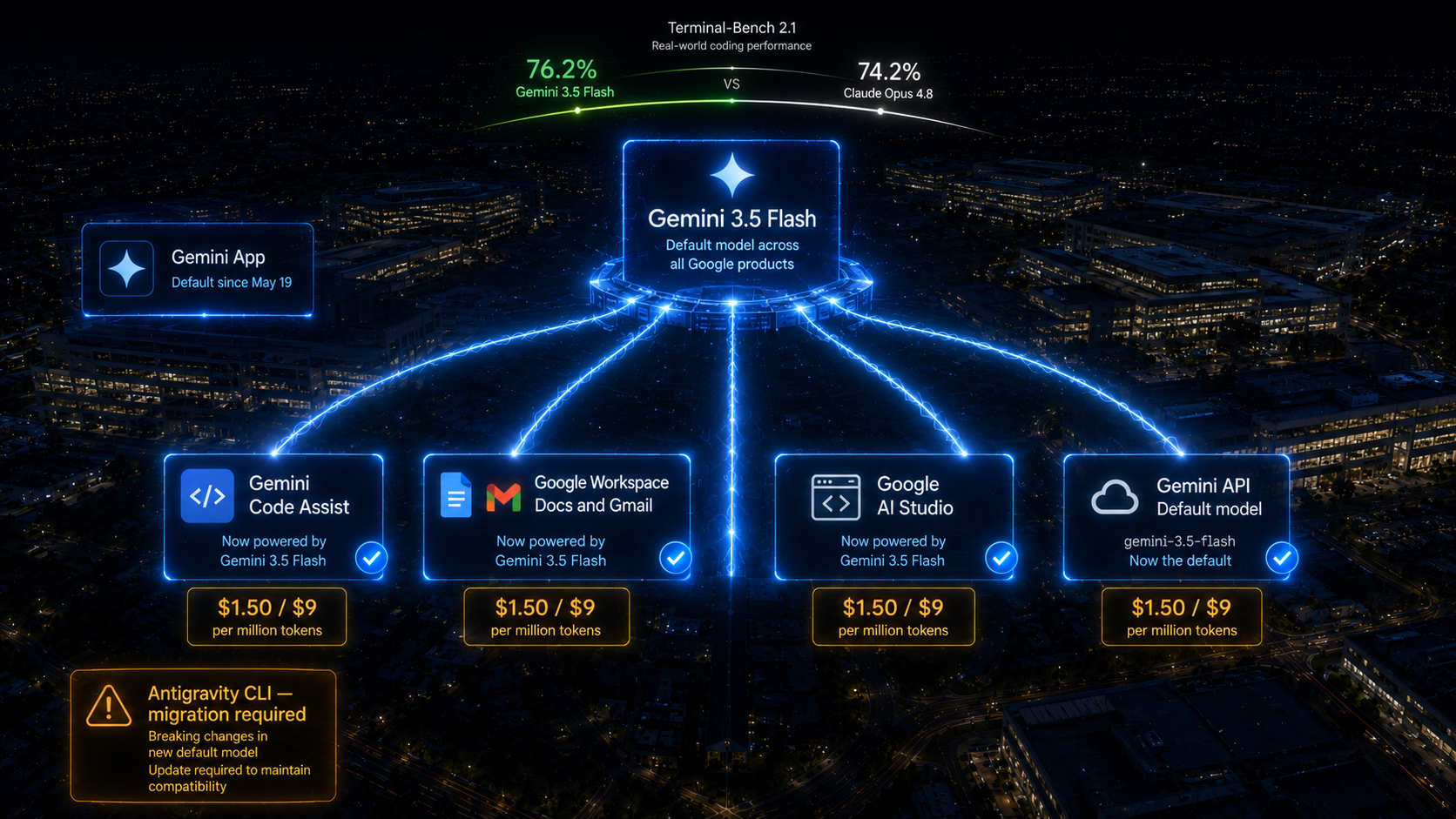
Google made Gemini 3.5 Flash the default model across all Gemini consumer and enterprise products on June 18, 2026, extending the default from the Gemini app — where it has been the default since Google I/O on May 19 — to Gemini Code Assist, Google Workspace AI features in Docs and Gmail, Google AI Studio and the Gemini API default model string.
Gemini 3.5 Flash's benchmark profile: 76.2 percent on Terminal-Bench 2.1, 83.6 percent on MCP Atlas, running at roughly four times the speed of competing frontier models. It beats Gemini 3.1 Pro on several coding and agent benchmarks while costing a fraction of Pro pricing. The Terminal-Bench 2.1 score of 76.2 percent is particularly significant in context: Claude Opus 4.8 scores 74.2 percent on the same benchmark. Gemini 3.5 Flash — a model priced at the efficiency tier — is outperforming Anthropic's current flagship model on the most practically important benchmark for enterprise terminal and coding automation, at less than a tenth of the per-token cost.
The pricing comparison is the data point that every enterprise AI infrastructure team should be modelling explicitly. Gemini 3.5 Flash costs $1.50 per million input tokens and $9 per million output tokens. Claude Opus 4.8 costs $5 per million input and $25 per million output. GPT-5.5 costs $5 per million input and $30 per million output. For the same output volume, Gemini 3.5 Flash costs approximately one-third of Sonnet-tier models and one-twelfth of Opus-tier models. For enterprises processing high volumes of AI-generated output — document analysis, code review at scale, automated reporting, agentic workflow execution — the pricing differential compounds into millions of dollars annually at enterprise workload volumes.
The Antigravity CLI migration that accompanied the June 18 Gemini 3.5 default rollout is the developer infrastructure change that enterprise engineering teams using Gemini in CI/CD pipelines must action immediately. Google confirmed that the Antigravity CLI replaced the Gemini CLI on June 18, 2026. Developers who have built workflows or CI/CD pipelines around the Gemini CLI need to switch to the Antigravity CLI to maintain functionality. The Antigravity CLI shipped at Google I/O 2026 and replaces the older Gemini CLI command set with a new interface designed for the Gemini 3.5 agentic model family. Enterprise engineering teams that have not yet migrated from the Gemini CLI to the Antigravity CLI may find that existing automated workflows have broken since the June 18 cutover. This is the immediate action item from the June 18 rollout for every team with Gemini CLI integrations in automated pipelines.
The Noam Shazeer departure — announced the same day — adds an important calibration to the Gemini 3.5 Flash default rollout. Shazeer was a co-lead of Gemini development, and his departure occurred on the same day that the Gemini 3.5 series completed its platform-wide default rollout. The product and platform announcements that Shazeer contributed to are now fully deployed. The research directions he influenced at Google are in the models that are running in production. His departure is not visible in the Gemini 3.5 Flash performance numbers — those reflect his work. It is a forward-looking signal about Google's next-generation model research, not a retrospective reflection on the current Gemini 3.5 architecture.
The Gemini 3.5 Pro trajectory — which Google confirmed at I/O 2026 in late May for a June 2026 release — is the model announcement that Shazeer's departure most directly shadows. Gemini 3.5 Pro is expected to offer deeper reasoning and longer context handling than Flash, positioned for complex enterprise and agentic workloads. Its release has not yet been confirmed as of June 19. The announcement that Gemini's technical co-lead is departing, in the same week that Gemini 3.5 Pro's release window is expected to open, will raise legitimate questions about whether the Pro release timeline is affected by the leadership transition. Enterprise procurement teams that have been waiting for Gemini 3.5 Pro benchmarks before making platform decisions should note the technical leadership transition as a possible factor in the release calendar.
For enterprise organisations that are Google Cloud customers, the June 18 Gemini 3.5 Flash default rollout has three immediate operational implications. The first is default model string verification: any API integration using the "gemini-3-5-flash" default model string rather than an explicit version-pinned model ID has been automatically updated to Gemini 3.5 Flash. Enterprise teams should verify which model their workflows are running and confirm that Gemini 3.5 Flash's performance on their specific workloads meets their quality requirements.
The second is the Workspace AI feature change: the AI writing assistance, summarisation and analysis features in Google Docs, Gmail and other Workspace applications that employees use daily are now running on Gemini 3.5 Flash rather than Gemini 3.1 Flash. For most enterprise use cases, this is an improvement — Gemini 3.5 Flash outperforms 3.1 Flash on most benchmarks. But the change is automatic and affects all Workspace users, which means that enterprise IT and operations teams should be aware of the model change and prepared to address any quality or behaviour questions from employees who notice different AI output characteristics.
The third is the Gemini Code Assist update: Gemini 3.5 Flash is now the default model powering Code Assist in enterprise development environments. Gemini 3.5 Flash's 76.2 percent Terminal-Bench score — above Claude Opus 4.8's 74.2 percent — makes it a meaningfully improved code assistance model for the terminal and command-line use cases that enterprise developers use most. The update to Code Assist is automatic and enterprise teams can expect to see improved code completion and terminal assistance quality from their existing Gemini Code Assist licences without any additional configuration.
At Legacies Techno, the Gemini 3.5 Flash default rollout across Google's enterprise product suite produces an immediate update to the cost modelling we use in enterprise AI platform design engagements. Gemini 3.5 Flash at $1.50/$9 per million tokens, with Terminal-Bench performance above Claude Opus 4.8, is the efficiency-tier model that validates a three-tier routing architecture for enterprise AI workloads. The routing logic our AI-Powered Platforms practice designs — frontier closed-source for complex reasoning, efficiency-tier for high-volume processing, open-weight for cost-sensitive automation — now has a clear efficiency-tier leader in Gemini 3.5 Flash for the workloads where its benchmark profile aligns with enterprise requirements.
Our Enterprise Software Development practice is immediately verifying Antigravity CLI migration status across every client environment that has Gemini CLI integrations in CI/CD pipelines. The June 18 Antigravity CLI cutover is a breaking change for engineering teams that have not yet migrated, and addressing it is a same-week priority.
Gemini 3.5 Flash at the default across every Google product is the efficiency-tier model statement for 2026. The enterprise AI platform decisions that were made assuming frontier-tier performance was available only at frontier-tier pricing now need to be re-evaluated against a model that delivers above-Opus benchmark performance at Haiku pricing.
Key Highlights
- Google made Gemini 3.5 Flash the default model across all Gemini consumer and enterprise products on June 18, 2026 — extending from the Gemini app (default since May 19 Google I/O) to Gemini Code Assist, Google Workspace AI in Docs and Gmail, Google AI Studio and the Gemini API default model string.
- Gemini 3.5 Flash scores 76.2 percent on Terminal-Bench 2.1 (above Claude Opus 4.8's 74.2 percent), 83.6 percent on MCP Atlas, and runs at approximately four times the speed of competing frontier models — priced at $1.50 per million input tokens and $9 per million output tokens.
- The pricing differential versus frontier alternatives: Gemini 3.5 Flash is approximately one-third the price of Sonnet-tier models (Sonnet 4.6 at $3/$15) and approximately one-twelfth the price of Opus-tier models (Opus 4.8 at $5/$25) on output tokens.
- The Antigravity CLI replaced the Gemini CLI on June 18 — a breaking change for enterprise teams with Gemini CLI integrations in CI/CD pipelines. Developers using the old Gemini CLI command syntax in automated workflows must migrate to the Antigravity CLI to maintain functionality.
- Noam Shazeer's departure from Google DeepMind was announced the same day as the Gemini 3.5 Flash default rollout — on the day the models he helped co-lead completed their platform-wide deployment. His departure is a forward-looking signal about Google's next-generation architecture research rather than a reflection on the current Gemini 3.5 production performance.
- Gemini 3.5 Pro — announced by Google at I/O 2026 for a June 2026 release — remains unannounced as of June 19. The leadership transition created by Shazeer's departure may affect the release timeline for the Pro model, though Google's engineering depth makes a significant delay unlikely.
- Enterprise organisations using Gemini API integrations with default model string references (rather than explicit version-pinned model IDs) have automatically updated to Gemini 3.5 Flash as of June 18. Verification of current model and quality baseline validation against Gemini 3.5 Flash performance is the immediate operational action.
- Workspace AI features in Docs, Gmail and other enterprise Workspace applications are now running on Gemini 3.5 Flash for all enterprise Workspace customers — an automatic improvement in AI assistance quality that does not require any customer action but should be noted for change management communications to enterprise end users.
Why This Matters
- Gemini 3.5 Flash scoring above Claude Opus 4.8 on Terminal-Bench 2.1 at one-twelfth the output token cost is the frontier model pricing event that should prompt every enterprise AI infrastructure team to re-evaluate its model tier routing strategy. The premise that above-Opus performance requires Opus pricing is no longer accurate for terminal and coding automation workloads. Enterprises that have been defaulting to Anthropic or OpenAI Opus-tier models for these workload types should validate Gemini 3.5 Flash performance against their specific use cases and model the cost impact of routing appropriate workloads to the efficiency tier.
- The Antigravity CLI breaking change is the immediate operational issue that supersedes any strategic analysis for enterprise teams with Gemini CLI integrations. Automated pipelines that broke on June 18 due to the CLI transition are the priority fix. The migration from Gemini CLI to Antigravity CLI is documented and straightforward, but it requires action before any other benefit from the Gemini 3.5 default rollout can be realised.
- The Workspace AI default change is the most broadly visible consequence of the June 18 rollout for enterprise IT teams. Every employee using AI writing assistance, summarisation or analysis in Google Docs and Gmail is now running Gemini 3.5 Flash rather than 3.1 Flash. For most employees, the change will be invisible or perceived as an improvement. The change management communication that should accompany it — "our Workspace AI is now powered by Gemini 3.5 Flash, which performs better on most tasks" — is a week-overdue IT communication for enterprises that have not already sent it.
- The Gemini 3.5 Pro release timing uncertainty created by Shazeer's departure is the procurement planning variable for enterprises waiting for the Pro model's benchmarks before finalising their Google Cloud AI platform commitments. The Flash model is in production and its performance is verified. The Pro model's release — which should offer deeper reasoning than Flash for complex enterprise workloads — remains on the June timeline but with an incremental uncertainty factor from the technical leadership transition. Enterprises that need the Pro benchmarks for platform decisions should model a possible two to four week delay rather than assuming the original timeline is intact.
Author
Legacies Engineering
RELATED NEWS
SEE ALLSEE ALL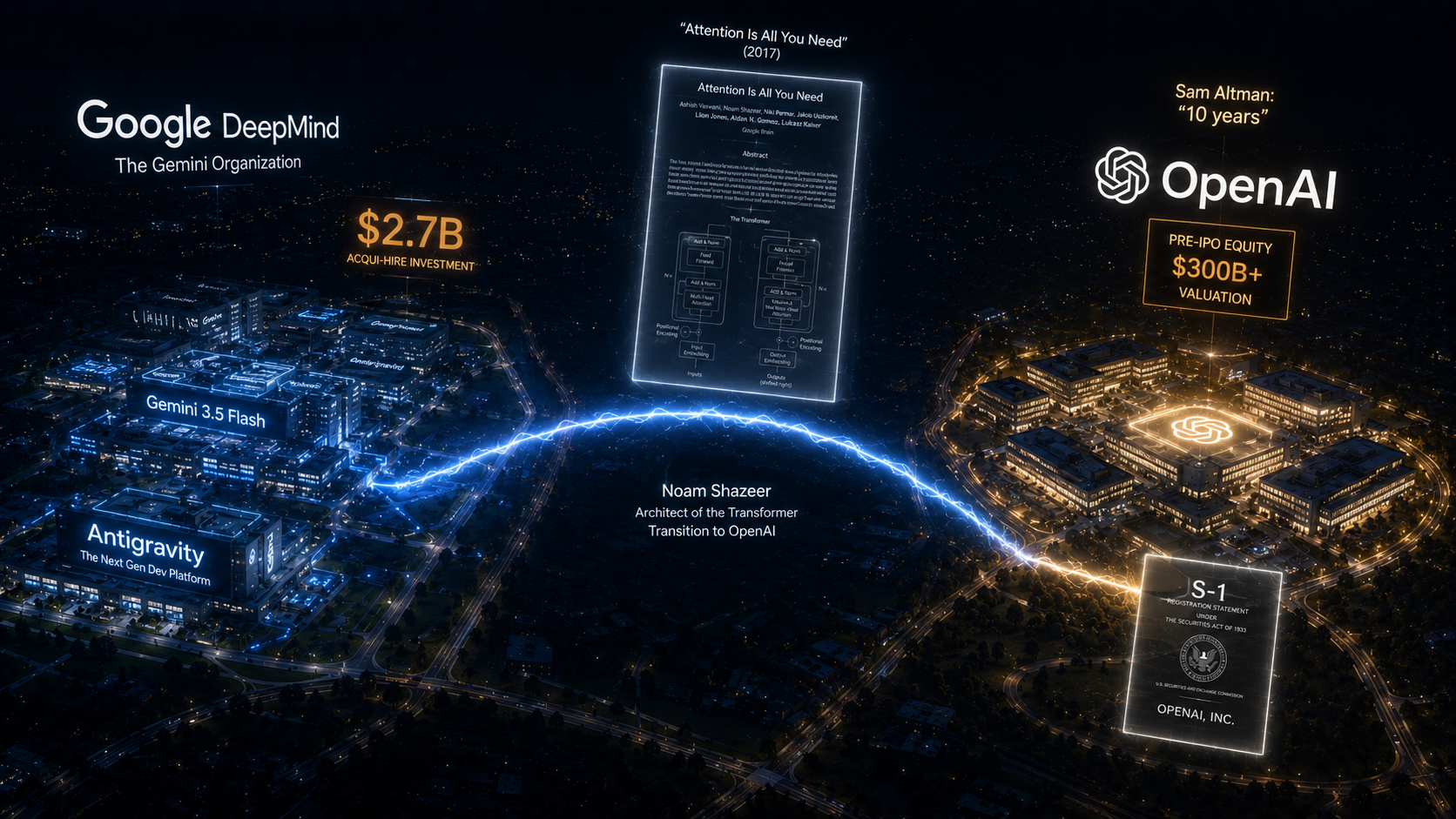
CONTACT
LET'S ENGINEER THE FUTURE — TOGETHER
.png)
.
.
/
.png)
Whether you're scaling a digital product, modernizing operations, or building from the ground up — Legacies Techno is your partner in crafting intelligent, enterprise-grade solutions that create lasting impact.
GET IN TOUCHGET IN TOUCH