
The AI Coding Market Has Consolidated: What SpaceX's $60B Cursor Acquisition Means for Every Enterprise Engineering Organisation
Four days after raising $75 billion in the largest IPO in history, SpaceX formally exercised its option to acquire Cursor — the AI code editor behind the fastest B2B revenue growth on record — for $60 billion in an all-stock deal announced June 16, 2026. The acquisition closes a consolidation cycle that has reshaped the AI developer tools landscape entirely in under eighteen months. As of June 16, 2026, the five major AI coding platforms are owned as follows: GitHub Copilot (Microsoft), Claude Code (Anthropic), Codex (OpenAI, which also acquired Astral in March), Grok Build and now Cursor (SpaceX/xAI). The only significant AI-native coding platform not owned by a major AI incumbent is Tabnine. For every enterprise engineering organisation that has been treating AI coding tool selection as a product decision, the June 16 acquisition makes it an infrastructure and vendor strategic decision — with the same consolidation dynamics, lock-in economics and long-term relationship implications as any other enterprise platform choice.
Date
Jun 16, 2026
Category
TECHNOLOGY
Reading Time
7 MINUTES
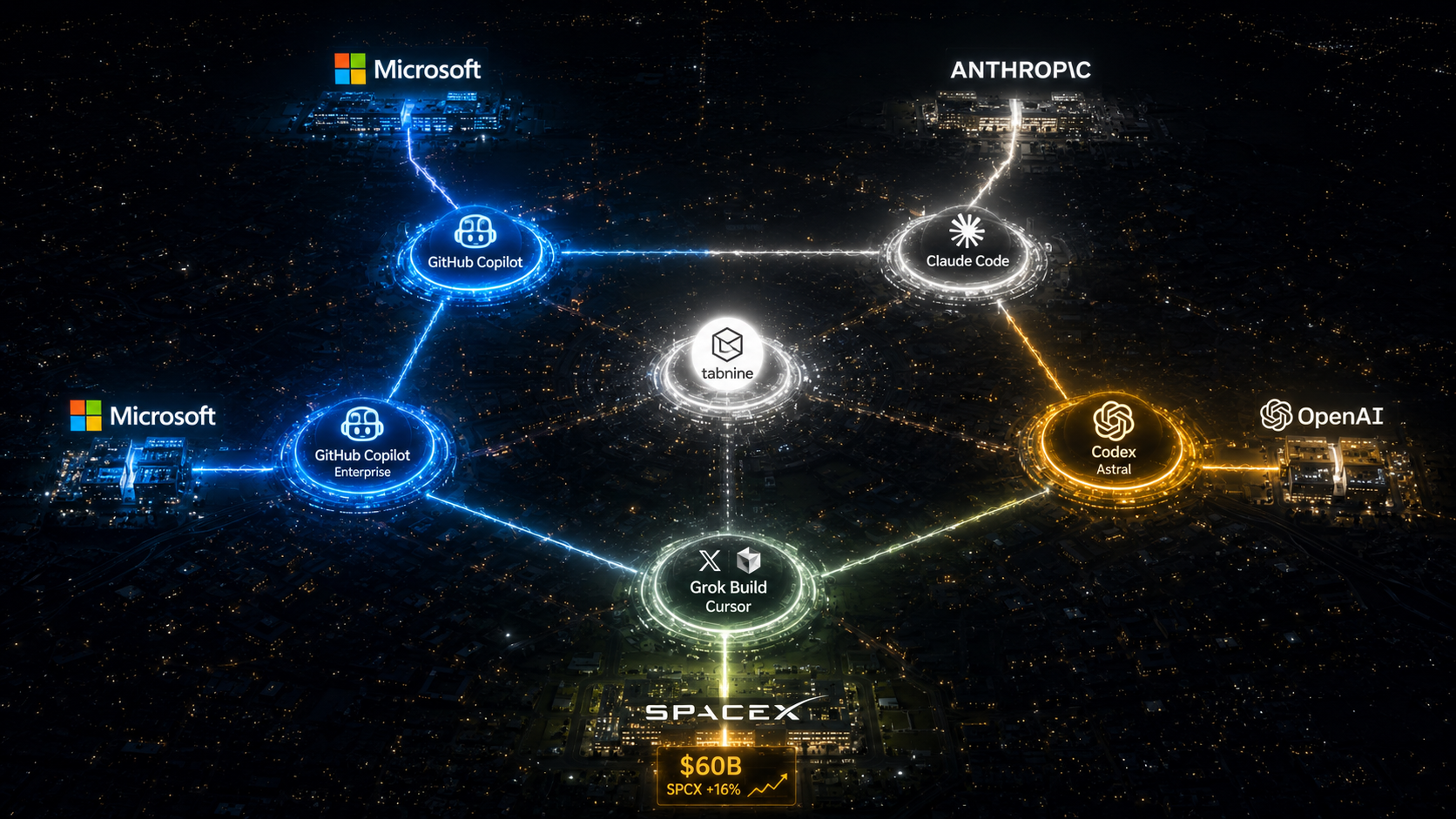
SpaceX has agreed to acquire Cursor in a $60 billion all-stock deal, just four days after its historic IPO. The transaction is expected to close in the third quarter of 2026. SpaceX first revealed in April that it had secured the right to buy Cursor, reserving the option at either $60 billion or paying a $10 billion break-up fee. Cursor CEO Michael Truell said: "We are excited to share that SpaceX has exercised their option to acquire Cursor in an all-stock transaction with the goal of building the world's most useful AI models."
The timing of the acquisition announcement — four days after SpaceX's SPCX stock began trading and immediately surged 19 percent on its debut — is not coincidental. SpaceX's stock had climbed from its $135 IPO price to more than $200 per share in pre-market trading on June 16, adding nearly $1 trillion to its valuation in the span of just a few days. Paying $60 billion in stock at a $2 trillion-plus valuation means SpaceX gives up approximately 3 percent of its equity. The same deal at the $1.77 trillion IPO valuation would have cost 3.4 percent dilution. At $2 trillion-plus, it costs marginally less. Bill Ackman posted on X: "One of the things that makes SpaceX so valuable is how valuable it is. The Cursor acquisition costs materially less in dilution because of SpaceX's high valuation."
The strategic logic is specific. SpaceX's AI division — built around xAI, Grok, and the Colossus Memphis data centre — had, despite being a centrepiece of its IPO promises, been in the midst of restructuring after running into repeated controversies. SpaceX's most recent Grok model placed 33rd on the Vals.AI vibe coding benchmark, well below older models from Anthropic, OpenAI and Google. The Cursor acquisition is designed to close that gap, giving xAI access to Cursor's $4 billion in annualised revenue, its 50,000 enterprise teams, and the joint model training that SpaceX and Cursor have been conducting on the Colossus Memphis supercluster. The Colossus facility — with more than 220,000 NVIDIA GPUs — is the compute environment where the joint Cursor/xAI coding model has been in training. That model, which SpaceX announced will be released soon on both the Cursor and Grok platforms, is the product at the centre of the acquisition's commercial logic.
The competitive picture around Cursor at the time of the acquisition is important context for enterprise procurement decisions. Cursor's market share had declined from 41 percent in June 2025 to about 26 percent in May 2026, according to spending data from Ramp, as Claude Code gained ground. Despite having $4 billion in annualised revenue, the startup had not reached profitability — the $2 billion in funding it had been planning to raise was not going to be enough to help it break even. The declining market share and the profitability gap are the two data points that made the SpaceX acquisition more compelling for Cursor's founders and investors than the independent path. A $60 billion all-stock exit — against a $50 billion fundraising valuation that had been planned just weeks earlier — is a favourable outcome even in a market share declining environment, when the alternative was raising additional capital into a competitive landscape where Claude Code was taking share.
D.A. Davidson analyst Adam Crisafulli said in a note to investors: "SpaceX hopes the Cursor team/product will give a jolt to its Grok AI business (especially in coding), which has so far failed to make a dent in the frontier market which is led by Anthropic, OpenAI, Google and Meta in the US, in that order." Vital Knowledge also noted that SpaceX has agreements to lease cloud compute capacity to Anthropic and Google worth roughly $26 billion combined annually, both of which include 90-day termination clauses — meaning SpaceX could reclaim that capacity for its own Cursor/Grok coding workloads if internal demand justifies it.
The AI developer tools consolidation map as of June 16, 2026 is the most consequential enterprise procurement landscape change in software development since Microsoft's acquisition of GitHub in 2018. Every major AI coding platform is now owned by a major AI lab or technology incumbent. The implications for enterprise tool selection, vendor lock-in and development workflow governance are specific and immediate.
The first implication is that AI coding tool pricing is no longer an independent market dynamic. When Claude Code is owned by Anthropic (which also runs the model layer), GitHub Copilot by Microsoft (which owns Azure and GitHub), Codex by OpenAI (which owns the model and now the Python toolchain through Astral), and Cursor/Grok Build by SpaceX/xAI, the pricing of each tool will increasingly reflect the parent company's strategic interest in the model platform beneath it rather than competitive market dynamics between independent products. Enterprises that have been optimising their AI coding tool costs based on per-seat pricing comparisons should model the longer-term pricing trajectory against each parent company's commercial incentives.
The second implication is data pipeline integration. Each AI coding tool now routes usage data, code context and developer behaviour signals back to the parent AI lab that controls both the tool and the model. Enterprises with strict data governance policies — particularly regulated industries where code repositories contain sensitive IP or regulated data — should evaluate what data each AI coding tool transmits to its parent company and how those data flows are governed. The consolidation of tools and models under the same parent makes this governance question more acute, not less.
The third implication is that Tabnine — the only remaining significant AI-native coding platform without a major incumbent parent — is the enterprise alternative for organisations that require independence from the model layer in their coding tool selection. Tabnine's on-premise deployment option is the specific feature that regulated industries with data sovereignty requirements have historically valued. In the consolidated market, it is the only major AI coding platform that offers this architecture without requiring a relationship with one of the five major AI labs.
At Legacies Techno, the Cursor acquisition reshapes the vendor assessment framework for enterprise AI coding tool selection. Our Enterprise Software Development practice evaluates AI coding tools not only on benchmark performance — which changes frequently — but on the vendor relationship architecture: data governance, pricing trajectory, parent company commercial alignment and the switching cost embedded in the tool's integration depth. The consolidation of June 2026 makes the parent company relationship the primary differentiator between tools that will converge on similar benchmark performance. Claude Code's parent is Anthropic. Codex/Astral's parent is OpenAI. Cursor/Grok's parent is SpaceX/xAI. Microsoft owns Copilot. The choice of AI coding tool is now a choice of which AI lab's commercial ecosystem an enterprise wants to be deepest in.
Our AI-Powered Platforms practice specifically tracks the Colossus-trained joint Cursor/xAI coding model that SpaceX has announced will be releasing soon. That model — trained on Colossus's 220,000 GPUs specifically for coding and knowledge work — is the first direct competitor to Claude Code's SWE-bench Pro performance that has been trained on compute infrastructure of equivalent scale. Its performance, pricing and enterprise deployment characteristics will determine whether the SpaceX/Cursor combination generates the competitive response its acquisition price implies.
The AI coding market consolidated in eighteen months. The enterprise AI coding tool decisions made in the next ninety days will be made in a market that will not consolidate further — it has already happened.
Key Highlights
- SpaceX formally exercised its $60 billion acquisition option for Cursor on June 16, 2026 — an all-stock deal expected to close in Q3 2026. Four days after SpaceX's historic $75 billion SPCX IPO, the company's surging valuation made the deal cost approximately 3 percent dilution rather than the 3.4 percent it would have cost at IPO pricing.
- The five major AI coding platforms are now all owned by major AI labs or technology incumbents: GitHub Copilot (Microsoft), Claude Code (Anthropic), Codex with Astral (OpenAI), Grok Build and Cursor (SpaceX/xAI). Tabnine is the only significant independent platform remaining.
- Cursor's market share had declined from 41 percent in June 2025 to approximately 26 percent in May 2026, driven by Claude Code's gains. Despite $4 billion in annualised revenue — up from $1 billion in November 2025 — Cursor had not reached profitability.
- SpaceX has been jointly training a new coding AI model with Cursor on the Colossus Memphis supercluster (220,000+ NVIDIA GPUs), which it announced will release soon on both the Cursor and Grok platforms. This is the product at the commercial centre of the acquisition.
- SpaceX's AI division (Grok 4.3) ranked 33rd on the Vals.AI vibe coding benchmark — well below Anthropic, OpenAI, Google and Meta — making Cursor's enterprise customer base, developer mindshare and model training infrastructure the acquisition's primary strategic value.
- SpaceX shares rose approximately 10-16 percent on the June 16 acquisition announcement, briefly making it the fourth most valuable US company at more than $2.7 trillion, overtaking Amazon.
- SpaceX has existing compute supply agreements with Anthropic and Google worth approximately $26 billion combined annually, with 90-day termination clauses. The Cursor acquisition gives SpaceX the internal demand justification to potentially reclaim that capacity for its own AI workloads.
- The consolidation is historically significant: AI coding tools have gone from a fragmented startup ecosystem to complete major-lab ownership in approximately eighteen months — the same consolidation timeline that took two to three cycles in cloud, databases and enterprise software.
Why This Matters
- The consolidation of AI coding tools under major lab ownership changes what enterprise tool selection is. Before June 2026, choosing between Claude Code, Cursor, Copilot and Codex was primarily a product decision based on developer preference and benchmark performance. After June 2026, it is a strategic platform decision that carries the same commercial and governance implications as choosing between AWS, Azure and Google Cloud. The parent company relationship, the data pipeline architecture, the pricing trajectory and the model ecosystem alignment are the primary differentiators. Product performance, which changes with every model release, is now a secondary consideration.
- Cursor's 26 percent market share decline from 41 percent in twelve months — driven by Claude Code — is the market signal that validates Claude Code's enterprise momentum beyond the market share statistics we covered in April. Real enterprise spending data from Ramp, which tracks actual corporate card purchases, confirms that Anthropic's market share gains are occurring in the enterprise segment where purchase decisions are most deliberate and switching costs are highest. That dynamic does not reverse easily.
- The Tabnine independence factor will increase in strategic value as the consolidated tools' data governance implications become more visible. Enterprises in regulated industries — where code repositories contain sensitive financial data, healthcare records, proprietary algorithms or regulated IP — should evaluate whether the data transmission architecture of each consolidated coding tool is compatible with their data governance policies, given that those tools now route data to companies that also own competing commercial interests in the AI market.
- The Colossus-trained joint Cursor/xAI model is the competitive announcement to watch in Q3 2026. If SpaceX releases a coding model trained on Colossus's 220,000 GPUs that performs above Claude Code and Codex on SWE-bench Pro, the market share dynamics in AI coding tools will shift again. If it does not, the acquisition's $60 billion price tag will require validation through Cursor's existing enterprise revenue rather than new model capability. Enterprise procurement teams should evaluate the model release before making long-term AI coding tool commitments to the SpaceX/Cursor platform.
Author
Legacies Engineering
RELATED NEWS
SEE ALLSEE ALL
CONTACT
LET'S ENGINEER THE FUTURE — TOGETHER
.png)
.
.
/
.png)
Whether you're scaling a digital product, modernizing operations, or building from the ground up — Legacies Techno is your partner in crafting intelligent, enterprise-grade solutions that create lasting impact.
GET IN TOUCHGET IN TOUCH