
The Father of the Transformer Joins OpenAI: What Noam Shazeer's Departure From Google Means for Every Enterprise Evaluating the AI Talent Race
On June 18, 2026, Noam Shazeer — VP of Engineering at Google DeepMind, co-lead of the Gemini model family, and co-author of the 2017 paper "Attention Is All You Need" that introduced the Transformer architecture underpinning every major AI model in the world — announced he is leaving Google to join OpenAI. Sam Altman posted on X: "noam is one of the people I have most wanted to work with since the very beginning of openai. only took 10 years. i think it will be worth the wait." Google had paid a reported $2.7 billion in August 2024 — through the Character.AI licensing and acqui-hire deal — specifically to bring Shazeer back to lead Gemini development. He stayed less than two years. The departure is not merely a talent story. It is the signal that OpenAI's IPO preparation is attracting the most consequential AI researchers in the world, that Google's $2.7 billion retention investment has not held, and that the talent dynamics of the frontier AI race have entered a phase where even the most expensive acqui-hires are insufficient to retain researchers who see the IPO equity opportunity at a competitor as the more compelling destination.
Date
Jun 18, 2026
Category
TECHNOLOGY
Reading Time
7 MINUTES
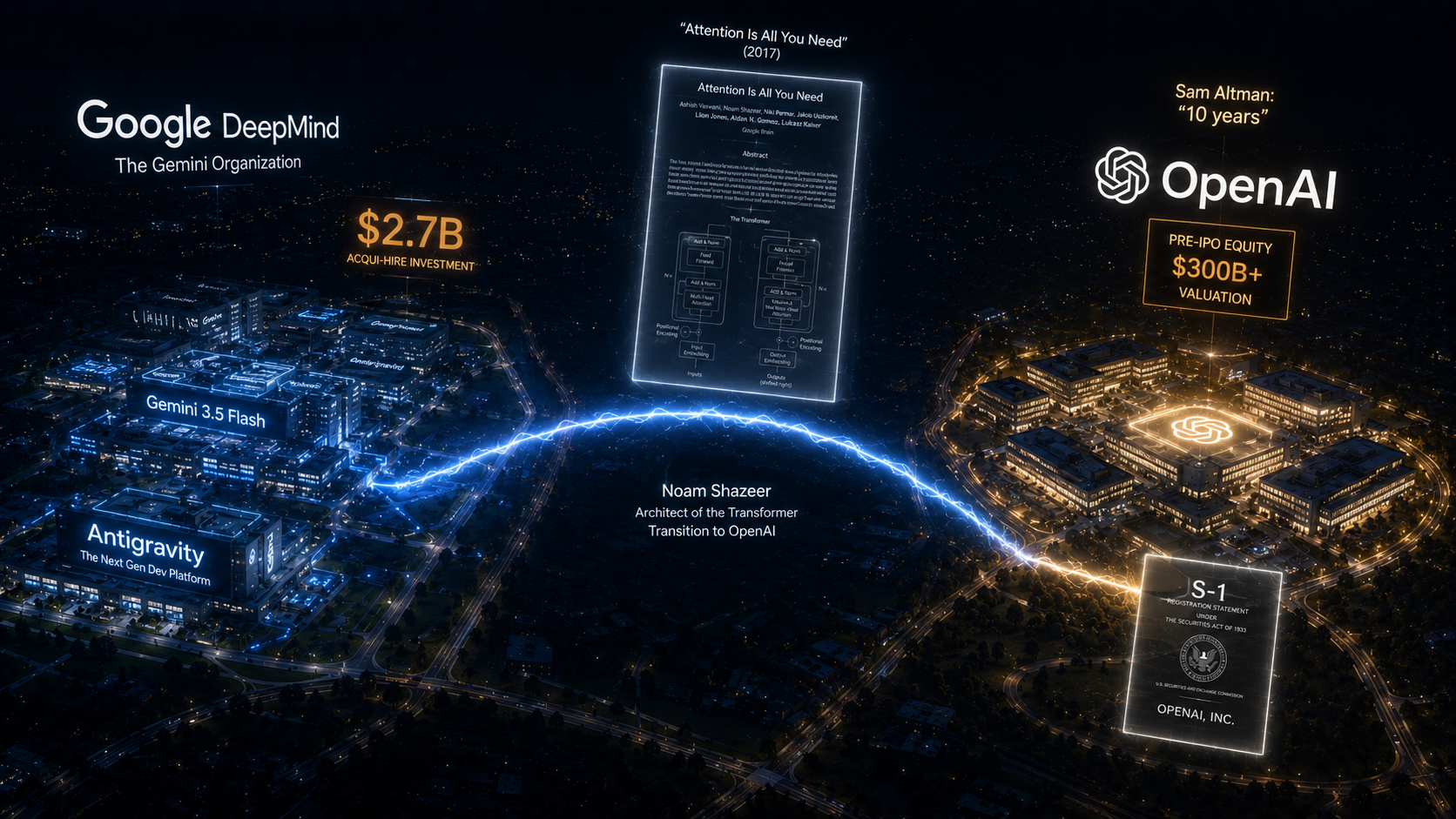
Noam Shazeer, VP of Engineering at Google DeepMind and co-lead of the Gemini AI models, announced on June 18, 2026 that he is leaving Google to join OpenAI. In his post on X, Shazeer wrote: "I'm excited to share that I'll be joining OpenAI and look forward to working with the exceptional team there. It was a difficult decision to move on. I'm incredibly proud of the amazing team at Google and everything we've built together." OpenAI CEO Sam Altman responded: "noam is one of the people I have most wanted to work with since the very beginning of openai. only took 10 years."
To understand why Shazeer's departure matters beyond any single individual's career move, the technical context is necessary. Shazeer is a co-author of the landmark 2017 paper "Attention Is All You Need," which introduced the Transformer architecture that underpins virtually every major large language model today — including GPT, Gemini and Claude. His contributions to mixture-of-experts techniques and other architectural innovations remain central to how frontier models are designed. Google reportedly paid around $2.7 billion in August 2024 specifically to bring Shazeer back from Character.AI, installing him as VP of Engineering and Gemini co-lead. His exit less than two years later — to join OpenAI as the company moves toward an IPO — underscores the difficulty even the largest companies face retaining elite AI researchers in the current talent market.
The financial context for the departure is the IPO equity story that explains why OpenAI can recruit Shazeer away from a $2.7 billion retention investment. OpenAI's confidential S-1 filed June 8-9 targets a valuation of $852 billion to $1 trillion. Pre-IPO equity at that valuation — particularly for someone with Shazeer's technical stature who can negotiate a leading research role — represents a financial opportunity that Google's public equity cannot match without a bespoke retention package that would set a precedent its HR organisation could not sustain across its broader research team. The IPO equity pull is not unique to Shazeer's departure. It is the mechanism that is drawing researchers and engineers toward OpenAI ahead of the listing from across the AI research community.
Google DeepMind has not publicly commented on Shazeer's departure. The departure adds to a pattern of high-profile exits from Google's AI research ranks, including several of the original Transformer co-authors. TechCrunch noted that OpenAI is bringing on "some big guns in the lead-up to its IPO," framing Shazeer as part of a deliberate pre-IPO talent strategy.
The Google specific implications of Shazeer's departure are worth assessing with precision rather than hyperbole. The most honest framing is the one that ThePlanetTools analysis provides: the loss is real, the narrative cost is significant, but Shazeer is one co-lead within a large Gemini organisation and a single departure does not derail a programme of Gemini's scale. The technical decisions he contributed to — the Gemini 3.5 Flash architecture, the agentic capabilities announced at Google I/O, the Antigravity platform — are already in production or near-production. The immediate impact on Gemini's product trajectory is limited. The longer-term question — whether this is an isolated decision or the leading edge of a broader pull toward OpenAI ahead of its IPO — is what Google's leadership team and enterprise customers should watch over the next sixty days.
The per-month cost context that the Build Fast With AI analysis provides is the number that puts the acqui-hire economics in the starkest relief. Google received approximately 22 months of Shazeer's work for its $2.7 billion Character.AI licensing deal — a per-month cost of approximately $122 million. Whether the Gemini improvements made during those 22 months justify that per-month cost is the question Google's investors are now being forced to answer publicly, at the same time that Alphabet's stock has barely moved on the news and the company faces a Gemini 3.5 Pro launch that Shazeer's departure potentially affects at the technical leadership level.
The enterprise implication of the Shazeer move is less about Google's near-term Gemini roadmap — which has enough engineering depth to continue without any single individual — and more about what the talent concentration at OpenAI ahead of its IPO says about the competitive dynamics of the frontier model race. When the co-author of the paper that invented the Transformer, the co-lead of Google's most advanced AI model family, and dozens of other researchers are choosing OpenAI at the IPO preparation stage, the organisation that is being built for the post-IPO research era at OpenAI is the one that will produce the model capability advances that matter for enterprise procurement decisions in 2027 and 2028.
The talent race is the leading indicator of the model capability race. The model capability race is the leading indicator of the enterprise procurement landscape. Shazeer at OpenAI does not change the enterprise AI market today. It is a signal about the enterprise AI market two to three years from now, when the models that Shazeer's architectural contributions influence will be the ones enterprise organisations are deploying in their most important workflows.
At Legacies Techno, we track AI research talent flows as a long-horizon input to our platform architecture recommendations. The systems we design for enterprise clients today will be in production for three to five years. The model capabilities that will matter most in 2028 and 2029 are being influenced by the research decisions being made today — and Shazeer's presence at OpenAI influences those decisions at the architectural level. Our AI-Powered Platforms practice incorporates a rolling assessment of frontier model capability trajectory — informed by both benchmark data and talent flow signals — into the platform durability analysis we provide to enterprise clients making long-term AI architecture commitments.
The most practical near-term enterprise action from the Shazeer news is to note it as a data point in the OpenAI vendor stability assessment. OpenAI is attracting the most senior AI researchers in the field at the pre-IPO stage. That attraction depends on the IPO proceeding at or above current valuation expectations. The enterprise organisations that are building their AI architectures on OpenAI's platform should incorporate the IPO timing and pricing outcome as a variable in their vendor stability model — not because OpenAI's survival is in question, but because the talent concentration and research investment it is building pre-IPO will determine the pace of its post-IPO model development relative to Anthropic, Google and the other providers.
The father of the Transformer has joined the company building toward the next generation of Transformers. That is the signal. The enterprise response is to track what he builds.
Key Highlights
- Noam Shazeer, VP of Engineering at Google DeepMind and co-lead of the Gemini AI model family, announced on June 18, 2026 that he is leaving Google to join OpenAI. He is a co-author of "Attention Is All You Need" (2017) — the paper that introduced the Transformer architecture underpinning every major AI model in the world, including GPT, Gemini, Claude and Grok.
- Google had paid approximately $2.7 billion in August 2024 — through the Character.AI licensing and acqui-hire deal — specifically to bring Shazeer back from the chatbot startup he had co-founded after leaving Google in 2021. He stayed less than 22 months.
- Sam Altman welcomed Shazeer on X: "noam is one of the people I have most wanted to work with since the very beginning of openai. only took 10 years." Shazeer called it "a difficult decision" but said he was "excited to join OpenAI."
- OpenAI confidentially filed its S-1 on June 8-9, targeting a $852 billion to $1 trillion valuation. The pre-IPO equity opportunity at that scale — particularly for a researcher of Shazeer's stature negotiating a leading research role — is the financial mechanism that overcame a $2.7 billion retention investment.
- Google DeepMind has not publicly commented on the departure. The cost of the acqui-hire deal that brought Shazeer back amounts to approximately $122 million per month over the 22-month tenure — a figure Google's investors are now evaluating in the context of his departure.
- The departure is part of a pattern TechCrunch described as OpenAI "bringing on big guns in the lead-up to its IPO" — suggesting a deliberate pre-IPO talent strategy alongside the S-1 filing and the Deployment Company launch.
- The immediate impact on Gemini's product trajectory is limited — Shazeer is one co-lead within a large organisation with significant engineering depth, and the Gemini 3.5 Flash architecture and Google I/O announcements are already in production. The longer-term question is whether this represents an isolated decision or the leading edge of broader pre-IPO talent flow toward OpenAI.
- Shazeer's specific mandate at OpenAI — exploring next-generation architectures including mixture-of-experts and next-generation attention mechanisms — positions him to influence the fundamental design of whatever comes after the current generation of large language models, with implications for frontier model capability that will become visible in 2027-2028 releases.
Why This Matters
- The Shazeer departure is the most consequential AI talent acquisition since Geoffrey Hinton left Google in 2023. The difference is that Hinton left to speak freely about AI risks; Shazeer is joining OpenAI to build next-generation AI architectures. The signal for enterprise procurement is directional: the researcher most responsible for the architectural foundations of modern AI has chosen to direct his next research chapter at OpenAI, at the pre-IPO stage when his equity stake aligns his interests with the long-term success of the organisation he is joining.
- The per-month acqui-hire cost of $122 million creates a specific pressure on Google's AI research retention strategy that was not present before the departure became public. Other senior Google DeepMind researchers are now doing the same calculation: is my current Google equity and compensation more or less attractive than pre-IPO OpenAI equity at $852 billion valuation? If the answer for more than a handful of researchers is "OpenAI," the talent concentration dynamic that makes OpenAI's next-generation architecture work credible will compound. Enterprise procurement teams tracking Google Cloud and Gemini as primary AI platform candidates should monitor the departure signal over the next sixty days.
- The architectural focus of Shazeer's OpenAI mandate — next-generation architectures beyond the current GPT series, including mixture-of-experts and attention mechanism innovations — is the technical bet that could produce the next step-change in frontier model capability. Enterprise organisations making long-term AI platform architecture decisions should account for the possibility that OpenAI's next-generation model, influenced by Shazeer's architectural contributions, produces a capability differential relative to Gemini and Claude that changes the platform hierarchy that currently exists.
- The IPO equity as talent retention tool is the dynamic that all frontier AI labs — not just Google — need to address. When a competitor is approaching a public listing at $852 billion to $1 trillion valuation, the pre-IPO equity it offers to senior researchers is a compensation instrument that private company equity packages and public company stock cannot easily match. Anthropic, which is also approaching an IPO, is in a similar position — the Anthropic equity its researchers hold is now worth substantially more at $965 billion valuation than the private equity grants they received at earlier funding rounds. The frontier AI talent market in the IPO year of 2026 is the most financially volatile in the field's history.
Author
Janani Sathyamurthy
RELATED NEWS
SEE ALLSEE ALL
CONTACT
LET'S ENGINEER THE FUTURE — TOGETHER
.png)
.
.
/
.png)
Whether you're scaling a digital product, modernizing operations, or building from the ground up — Legacies Techno is your partner in crafting intelligent, enterprise-grade solutions that create lasting impact.
GET IN TOUCHGET IN TOUCH