
The AI IPO Triple-Header: What SpaceX at $1.77 Trillion, OpenAI's S-1 and Anthropic's $47B ARR Mean for Every Enterprise's AI Vendor Assessment
In the space of ten days — June 1 to June 11, 2026 — the three companies that together define the infrastructure, model and agentic future of enterprise AI filed for, or began trading in, the public markets simultaneously. Anthropic filed its confidential S-1 on June 2 at a $965 billion valuation, disclosing a $47 billion annualised revenue run rate. OpenAI filed its confidential S-1 on June 9, targeting a valuation of $852 billion to $1 trillion with $25 billion in annualised revenue and a projected $14 billion loss in 2026. SpaceX — which absorbed xAI in February and now combines Starlink, Falcon, Starship and the Grok AI division under one ticker — priced its IPO on June 11 at $135 per share, raising $75 billion at a $1.77 trillion valuation, the largest IPO in recorded history. Enterprise AI vendor assessment has just been transformed by the disclosure requirements of public market filings. Every enterprise building on these platforms now has more financial visibility into their AI vendor's sustainability than at any prior point. Here is what that visibility reveals.
Date
Jun 11, 2026
Category
Industry
Reading Time
7 minutes
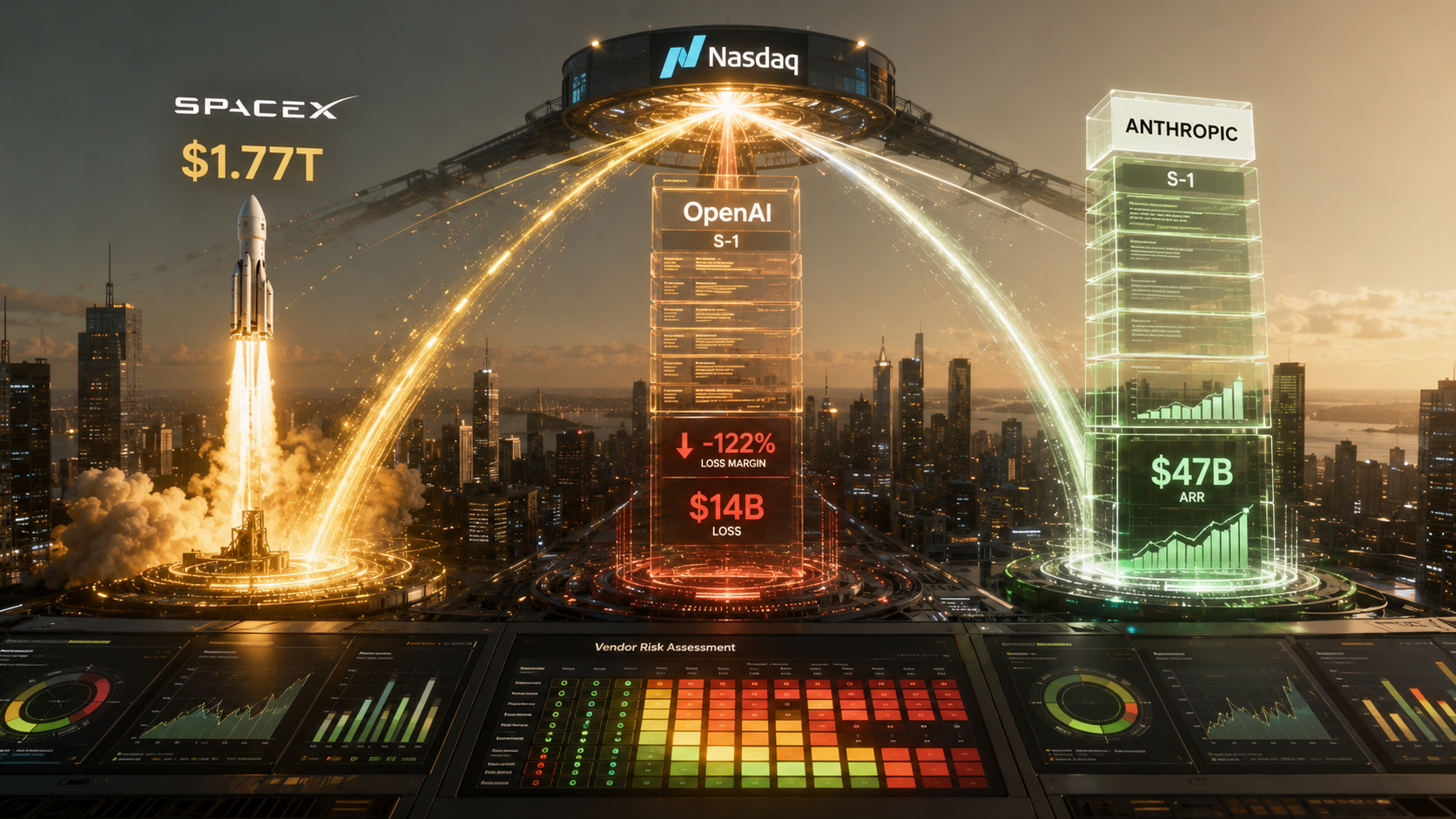
The IPO wave did not arrive suddenly. Each filing was the product of months of preparation that the enterprise AI community has been tracking since the beginning of the year. What arrived suddenly was the simultaneous disclosure of financial data that had previously been available only to the investors who had signed NDAs and received data room access. The S-1 filing — whether confidential or public — is the moment when a company's revenue, costs, margins, growth trajectory and unit economics are documented in a format designed for institutional scrutiny. That same scrutiny is now available to every enterprise technology and procurement team making AI platform decisions.
OpenAI filed a confidential S-1 registration statement with the SEC on June 8-9, 2026, targeting a valuation of $852 billion to $1 trillion. The company has tapped Goldman Sachs and Morgan Stanley to manage the offering. The timing window for the listing stretches from September 2026 into Q4, depending on market conditions. OpenAI's annualised revenue hit roughly $25 billion by February 2026, up from $6 billion in 2024 and $2 billion in 2023 — 12.5x growth in three years. Enterprise now accounts for more than 40 percent of revenue, on pace to reach parity with consumer by year end.
The OpenAI financial picture that emerges from its pre-IPO disclosures is the most sobering financial portrait of any company approaching public markets at this scale. OpenAI projects a $14 billion operating loss for 2026. The company's Q1 2026 non-GAAP operating margin was negative 122 percent — for every dollar of revenue, OpenAI spent $2.22. The company expects to lose approximately $74 billion cumulatively before reaching profitability in 2029-2030, with $600 billion in compute commitments through the decade and $1.4 trillion in data centre commitments over eight years.
The OpenAI loss trajectory is the enterprise vendor risk data point that procurement teams should be modelling explicitly. A vendor projecting $74 billion in cumulative losses before profitability, with $1.4 trillion in infrastructure commitments, is a vendor whose continued operation depends entirely on continued access to equity capital. The enterprise AI platform risk question — will my AI vendor still be operational and investing in this platform in three to five years? — has a conditional answer for OpenAI: yes, if the public markets price its IPO at a valuation that funds the losses; possibly not, if they do not. The Anthropic comparison is direct and important: Anthropic is expected to post a small operating profit for Q2 2026 after doubling revenue quarter-on-quarter. Two AI labs, both approaching public markets in the same window. One projecting losses through 2030. One approaching operating profitability.
The Anthropic S-1 disclosure data enriches the enterprise vendor picture significantly. Anthropic's confidential IPO filing confirmed a revenue run rate of $47 billion and a valuation of $965 billion. The $47 billion ARR figure — first disclosed in the IPO filing rather than a press release — is 57 percent higher than the $30 billion ARR figure that was the most recent public data point from April. The growth from $30 billion to $47 billion ARR in approximately six weeks suggests a revenue acceleration trajectory that the pre-IPO private data had obscured. For enterprise procurement teams evaluating Anthropic's vendor stability, the $47 billion ARR and the near-profitability at Q2 2026 are the most consequential financial data points in the AI vendor landscape this year.
SpaceX made financial history on June 12, 2026, completing the largest initial public offering ever recorded — $75 billion raised at $1.77 trillion valuation through 555.6 million shares at $135 each, more than double Saudi Aramco's 2019 record of $29.4 billion. The company's S-1 disclosed three segments: Connectivity (Starlink, 10.3 million subscribers, profitable), Space (Falcon and Starship, development-stage), and AI (xAI, Grok, Colossus data centre, $14 billion in operating losses and AI capex representing 76 percent of group capex in Q1 2026).
The SpaceX S-1's AI segment disclosure is the financial detail that enterprise technology leaders with compute infrastructure dependencies should register. The xAI division — the Colossus Memphis facility with 220,000 NVIDIA GPUs that Anthropic has a compute supply agreement with — is burning approximately $6 billion annually in operating losses, with AI capex at 76 percent of SpaceX's total group capital expenditure in Q1 2026. The compute capacity that Anthropic is accessing through SpaceX's infrastructure is being funded by the Starlink profitability that SpaceX disclosed in its IPO filing. Starlink is the profitable anchor that funds both the Starship development losses and the xAI compute losses — which means that the compute supply chain that benefits Anthropic's model deployment is ultimately dependent on Starlink subscriber revenue continuing to grow.
Also on June 11, 2026, OpenAI announced that enterprise customers can access its frontier AI models and Codex through their existing Oracle Universal Credits. The OpenAI-Oracle partnership allows Oracle Cloud enterprise customers to deploy OpenAI API services through their UCM contracts without separate procurement, legal review or billing architecture. Oracle Universal Credits cover over $100 billion in annual enterprise cloud spend. The Oracle Universal Credits integration is the enterprise distribution move that expands OpenAI's reach into the existing Oracle enterprise customer base — which includes the majority of Fortune 500 companies that have made multi-year Oracle cloud commitments. For procurement teams at organisations with Oracle UCM agreements, OpenAI API access is now a configuration exercise rather than a new vendor relationship.
At Legacies Techno, the AI IPO triple-header produces specific and actionable vendor assessment updates for every enterprise client engagement we are currently managing. The most important enterprise implication is that the financial disclosure requirements of public market filings have permanently changed the quality of information available for AI vendor assessment. The $47 billion Anthropic ARR, the OpenAI $14 billion projected loss and negative 122 percent operating margin, and the SpaceX xAI segment burning $6 billion annually — these are the financial inputs that transform AI vendor assessment from qualitative capability evaluation to quantitative financial risk modelling.
Our AI-Powered Platforms practice updates its vendor stability framework to incorporate IPO S-1 financials as a required input for any AI platform design engagement. The platforms we design for enterprise clients must be stable through a five to seven year deployment horizon. Vendor financial stability — particularly the path to profitability and the capital structure that funds losses between now and that path — is the framework that the IPO disclosures finally make documentable. Our Enterprise Software Development practice is specifically watching the OpenAI Oracle Universal Credits integration for client procurement implications. Enterprises with Oracle UCM agreements that have been managing separate OpenAI API procurement should evaluate whether Oracle UCM integration simplifies their AI API sourcing and how the UCM pricing compares to direct OpenAI API contracts.
The AI IPO window of June 2026 is the most important capital markets event in enterprise AI history. The financial disclosures it produces are the enterprise vendor assessment inputs that every procurement team should be incorporating into their AI platform decisions now.
Key Highlights
- Three of the most consequential AI-infrastructure companies in the world filed for or began public market trading in a ten-day window: Anthropic (confidential S-1, June 2, $965 billion valuation), OpenAI (confidential S-1, June 8-9, targeting $852 billion to $1 trillion) and SpaceX/xAI (IPO priced June 11 at $135, $1.77 trillion valuation, $75 billion raised — the largest IPO in history).
- Anthropic's confidential S-1 disclosed a $47 billion annualised revenue run rate — 57 percent higher than the $30 billion ARR figure publicly reported in April — and confirmed near-operating-profitability in Q2 2026, with the company expected to post a small operating profit.
- OpenAI's S-1 disclosures reveal a negative 122 percent operating margin in Q1 2026, a projected $14 billion loss in 2026, $74 billion in projected cumulative losses before profitability in 2029-2030, and $600 billion in compute commitments through the decade. Revenue has grown 12.5x in three years to $25 billion annualised.
- SpaceX's S-1 segments the AI division (xAI, Grok, Colossus data centre with 220,000 NVIDIA GPUs) separately — showing AI capex at 76 percent of group capital expenditure in Q1 2026 and approximately $6 billion in annual AI segment operating losses, funded by Starlink connectivity profitability ($11.4 billion revenue, $4.4 billion operating income in 2025).
- SpaceX received $250 billion in IPO orders against a $75 billion raise — the most oversubscribed large IPO in history — triggering significant rotation out of established Magnificent Seven positions as hedge funds reallocated to the new public AI infrastructure company.
- OpenAI and Oracle announced on June 11 that enterprise customers can now access OpenAI frontier models and Codex through Oracle Universal Credits — integrating OpenAI API access into the $100 billion-plus annual Oracle enterprise cloud spend without separate procurement or legal review.
- The financial contrast between the two frontier AI labs approaching IPO is the most consequential enterprise vendor risk data now available: Anthropic at $47 billion ARR with near-profitability, versus OpenAI at $25 billion ARR with $14 billion projected losses and a path to profitability not before 2029-2030.
- zInvestment bankers advising both Anthropic and OpenAI have noted a first-mover advantage to being the first AI model company to list — creating competitive pressure between the two firms that mirrors their model capability race with a capital markets dimension.
Why This Matters
- The IPO disclosure window has permanently changed enterprise AI vendor assessment. The S-1 financial data now available for Anthropic and OpenAI — revenue, margins, cost structure, compute commitments, path to profitability — is the quantitative risk framework that enterprise procurement teams have been unable to apply to AI vendor selection because private company opacity prevented it. Every enterprise making AI platform decisions should be incorporating the S-1 financials into its vendor assessment. The platforms we build enterprise architectures on must be stable for five to seven years. The financial data to assess that stability is now available.
- The OpenAI negative 122 percent operating margin and $74 billion projected cumulative losses before profitability is the vendor risk data point most enterprise procurement frameworks have never previously encountered. A vendor losing $2.22 for every dollar of revenue, with $1.4 trillion in infrastructure commitments and a profitability timeline of 2029-2030, is not a vendor with a clear operational risk profile. The question is not whether OpenAI will continue to operate — it likely will, because its investor base includes Microsoft, NVIDIA, SoftBank and Amazon, none of whom have an interest in allowing it to fail. The question is whether its competitive position, its pricing discipline and its model development investment will be shaped by public market accountability or by the requirements of continuous private capital raises.
- The SpaceX AI segment disclosure is the supply chain transparency that Anthropic enterprise clients specifically need to understand. The compute access Anthropic provides to enterprise clients ultimately depends on the Colossus facility's continued operation, which depends on xAI's capital budget, which depends on SpaceX's overall financial health, which depends on Starlink subscriber revenue. The supply chain is now traceable from the enterprise API call through the compute contract to the Starlink revenue that funds it. That is qualitatively better vendor risk visibility than was available before the IPO filings.
- The Oracle Universal Credits OpenAI integration is the most immediately actionable enterprise procurement development in the June 11 news. Enterprises with Oracle UCM agreements can immediately evaluate whether OpenAI API access through existing credits is commercially superior to their current API procurement arrangement. The integration removes the separate vendor relationship management overhead for enterprises that already operate within Oracle's cloud ecosystem — which represents the majority of large enterprise IT environments.
Author
Legacies Engineering
RELATED NEWS
SEE ALLSEE ALL
The Most Important Enterprise AI Essay of 2026: What Satya Nadella's Token Capital Framework Means for Every Organisation Building on AI
After Fable 5: The Enterprise AI Resilience Architecture Every Organisation Must Build Before the Next Government Directive
The Day the Government Pulled the Plug: What the Fable 5 Shutdown Means for Every Enterprise Building on Frontier AI
CONTACT
LET'S ENGINEER THE FUTURE — TOGETHER
.png)
.
.
/
.png)
Whether you're scaling a digital product, modernizing operations, or building from the ground up — Legacies Techno is your partner in crafting intelligent, enterprise-grade solutions that create lasting impact.
GET IN TOUCHGET IN TOUCH