
The Most Important Enterprise AI Essay of 2026: What Satya Nadella's Token Capital Framework Means for Every Organisation Building on AI
Microsoft CEO Satya Nadella published an essay on June 14, 2026 titled “A frontier without an ecosystem is not stable.” It has since accumulated 28 million views on X. The essay introduces two concepts that belong in every enterprise AI strategy conversation: human capital and token capital. It proposes a specific three-layer architecture — private evaluations, private reinforcement learning environments, and an institutional knowledge base — that Nadella calls a “hill climbing machine.” For every enterprise leader currently managing AI deployment at scale, Nadella's essay is the strategic reframing the moment requires.
Date
Jun 24, 2026
Category
Industry
Reading Time
7 minutes
There is a specific kind of essay that only a CEO in a position of genuine cognitive dissonance can write. Satya Nadella's June 14 essay is that kind. He is the CEO of a company that has invested billions in OpenAI — the frontier model lab that his essay most directly warns against. He is the CEO of a company that is itself a major AI model provider through Azure, Copilot and GitHub. And he is simultaneously the CEO who is most publicly arguing that enterprises should not cede their competitive advantage to frontier model providers. The essay's tension is its value. A self-serving message about AI safety would be transparent. A message that explicitly undermines the commercial interests of your largest AI partner — while simultaneously describing the architecture that your own Azure and Copilot products are positioned to deliver — is the kind of message that requires a closer reading.
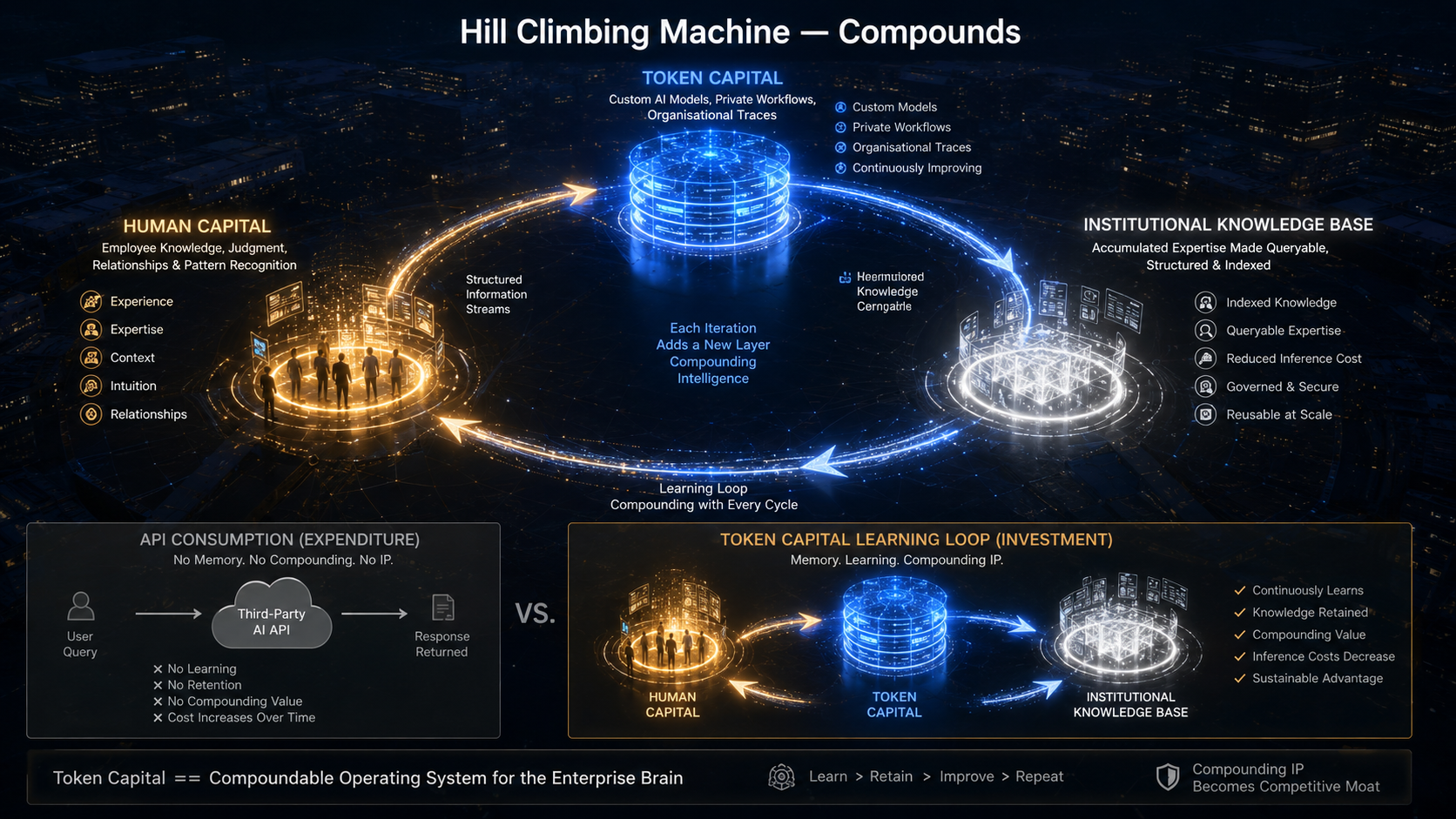
Nadella introduced what he described as human capital and token capital, setting out a model for how businesses could organize work, intellectual property and employee learning as AI agents take on more complex tasks. Under Nadella's framing, human capital includes employees' knowledge, judgment, relationships, ingenuity and ability to recognize important patterns. Token capital includes AI-derived digital intelligence — custom models, workflows, and traces of human-AI interactions that a company builds and owns.
The distinction is the most important strategic concept introduced in enterprise AI in 2026 — not because it is technically new, but because it provides the vocabulary that enterprise leadership teams have been lacking to describe the investment decision they are making when they deploy AI. The question that every enterprise AI investment should be answering — and that almost none are currently structured to answer — is: are we building token capital, or are we spending on someone else's? Deploying frontier model APIs for internal workflows and generating outputs is spending on token capital that belongs to the model provider. Building the organisational infrastructure that captures the patterns, the outcomes and the institutional knowledge generated by those workflows and uses it to improve AI performance on organisation-specific tasks — that is building token capital that belongs to the enterprise.
Nadella said the bigger challenge for companies is no longer adopting AI, but making sure their knowledge and expertise do not lose value as AI systems become better at learning and replicating human skills. He prescribed a three-layer architecture designed to sit between a company's workforce and whatever frontier model it subscribes to. Companies need to build private evals that capture whether a model is actually improving against outcomes that matter to the business, alongside private reinforcement learning environments that let models grow stronger on real traces from inside the organisation and a knowledge base that makes institutional memory queryable and use of tokens more efficient. He calls the resulting system a hill climbing machine that, unlike most assets, compounds.
The three layers are worth examining individually because each has a specific implementation architecture that enterprise technology teams can build toward. Private evaluations — the first layer — are the measurement infrastructure that connects AI model performance to business outcomes rather than to external benchmark scores. The DRACO benchmark, the SWE-Bench Pro scores, and every other external benchmark are measurements of what a model can do in general. A private evaluation is a measurement of what a model can do on the specific documents, queries, decisions and workflows that your organisation runs. The organisation that has built private evaluations can route workloads to models based on verified performance on its own distribution — not on benchmark extrapolation. That routing precision is the foundation of cost-efficient, quality-controlled multi-tier model architecture.
Private reinforcement learning environments — the second layer — are the infrastructure that allows a model to improve its performance on organisation-specific tasks through feedback on real organisational outputs. When a workflow generates an outcome — a code change that passed review, a document that received stakeholder approval, a customer interaction that converted — that outcome is a training signal for the model that generated the output. Capturing those signals in a form that improves subsequent model behaviour on equivalent tasks is what Nadella means by building token capital. The enterprise that captures those signals owns the improvement. The enterprise that does not capture them is paying for inference that teaches the model provider nothing useful and teaches the enterprise nothing at all.
The institutional knowledge base — the third layer — is the retrieval architecture that makes accumulated organisational expertise queryable in a way that reduces inference cost and improves output quality simultaneously. When the organisation's domain knowledge, historical decisions, institutional context and accumulated expertise are structured and indexed for AI retrieval, the model's inference quality on organisation-specific tasks improves significantly compared to general knowledge retrieval. The organisation that has built this layer is not paying frontier model pricing to compensate for the model's ignorance of its specific domain. It is paying frontier model pricing to apply general reasoning capability to a knowledge base that the model could not have without the organisation's investment in building it.
Nadella argued that each improvement to a workflow could generate additional information for training, evaluation and refinement, and that the resulting training signal accelerates the accumulation of tacit knowledge unique to the firm — an advantage he described as hard to replicate regardless of any new individual model capability. His framing was direct: you can offload a task, or even a job, but you can never offload your learning, and the future of the firm is the ability to compound that learning across people and AI.
That idea — that learning itself cannot be offloaded — is the strategic test for every enterprise AI deployment. Is this workflow deployment generating learning that the enterprise owns and can compound? Or is it generating outputs that the enterprise consumes and the model provider learns from? The difference between the two is the difference between building a compounding competitive advantage and paying a recurring cost for a capability that your competitors can purchase at the same price.
The warning against frontier model consolidation that runs through the essay is striking from a CEO in Nadella's position. He cautioned against a world where every company across every sector cedes value to a few models that absorb everything they see, arguing that if all the value accrues to only a handful of models, the political economy will not tolerate it — there is, in his words, no societal permission for an AI future that hollows out entire industries.
The political economy framing is significant. Nadella is not making a technical argument about why enterprises should build token capital. He is making a social contract argument: the permission that AI companies have to operate at the scale they are operating at — consuming energy, displacing workers, restructuring industries — depends on the broad distribution of AI benefits across the economy. When AI value concentrates in a handful of model providers, the political response will be regulatory intervention that constrains everyone, including Microsoft. The self-interest in broad AI value distribution is as real as the ethical argument for it.
The VentureBeat analysis published this week adds the internal Microsoft context that makes the essay's cognitive dissonance fully visible. At the end of this month, Microsoft is cutting off Claude Code licences for some internal departments — having exhausted portions of its annual AI budget due to token-based billing, after monthly usage rates reached 84 to 95 percent and per-engineer API costs ranged between $500 and $2,000 monthly. The CEO who is urging enterprises to build their own token capital and control their own learning loops is simultaneously managing the budget pressure of his own company's frontier model API costs. The essay is not purely philosophical. It is also a CEO processing the operational reality of an economy built on metered frontier model access and thinking through what the alternative should look like.
The essay also reflects Nadella's competitive concern about the current frontier model concentration. Although he did not name specific companies, his message read as a direct challenge to OpenAI, Anthropic and Google: that the world's curiosity cannot be handed to a handful of companies and called progress. The statement is philosophically aligned with the anti-concentration message — and commercially aligned with Microsoft's interest in a world where AI capability is distributed through an ecosystem of providers rather than consolidated in three frontier labs whose infrastructure Microsoft partially owns but does not control.
At Legacies Techno, Nadella's token capital framework is the clearest strategic language we have seen for describing what our three practice areas are actually building for enterprise clients. Our AI-Powered Platforms practice builds the three-layer architecture Nadella prescribes: the private evaluation infrastructure that connects AI model performance to organisation-specific business outcomes; the workflow tracking architecture that captures training signals from production AI usage; and the institutional knowledge base that makes accumulated organisational expertise queryable by AI agents. These are not add-ons to AI deployment. They are the architecture that determines whether AI deployment generates token capital or merely generates AI expenditure.
The distinction between deploying AI and building token capital is the most consequential strategic question any enterprise AI leader can ask about their current AI programme. A programme that deploys frontier models for specific workflows and measures success by usage metrics is generating AI expenditure. A programme that captures the performance data, the outcome signals and the institutional knowledge generated by those workflows — and uses that data to improve the AI's performance on organisation-specific tasks — is building token capital. Both programmes produce AI outputs. Only one produces a compounding competitive advantage.
Our Enterprise Software Development practice designs the data capture and knowledge management architecture that turns production AI deployment into token capital accumulation. Every workflow our engineering team builds is designed to generate structured feedback on AI output quality, capture the patterns that distinguish successful outputs from unsuccessful ones, and make that feedback available as training signal for subsequent workflow improvement. That design discipline is the difference between a production AI system that performs the same in year two as it did in year one — because it has learned nothing — and one that performs measurably better, because the learning loop is built into the production architecture.
Our Smart Automation practice addresses the third layer of Nadella's framework directly: the institutional knowledge base. The automation workflows that generate the highest sustained returns in enterprise environments are the ones that run on knowledge bases that encode the organisation's accumulated domain expertise — the historical decisions, the exception patterns, the business rules that experienced employees carry in their heads and that generic AI models cannot access without the retrieval architecture that makes that knowledge queryable. Building that retrieval architecture is the implementation work that converts institutional knowledge from an intangible asset into a component of token capital that the organisation owns and can compound.
Nadella published an essay. It has 28 million views. The most important word in it is compounds. The organisations that start compounding their token capital today will have an advantage in 2028 that no model release will close.
Key Highlights
- Microsoft CEO Satya Nadella published “A frontier without an ecosystem is not stable” on June 14, 2026 — an essay that has accumulated 28 million views on X and is the most strategically significant enterprise AI framework piece published by a sitting technology CEO this year.
- Nadella introduces two concepts for the AI-era enterprise balance sheet: human capital (knowledge, judgment, relationships, ingenuity and pattern recognition of employees) and token capital (the AI systems, custom models, workflows and traces of human-AI interactions that a company builds and owns). The two must compound together.
- Nadella prescribes a three-layer “hill climbing machine” architecture: private evaluations (measuring model performance against organisation-specific outcomes, not external benchmarks); private reinforcement learning environments (improving model performance on real organisational traces); and an institutional knowledge base (making accumulated expertise queryable and inference more efficient).
- The key strategic distinction: learning itself cannot be offloaded — the future of the firm is the ability to compound that learning across people and AI. The learning loop, not the model, is the competitive asset that compounds.
- Nadella's warning against frontier model consolidation is striking from OpenAI's largest investor: a world where every company across every sector cedes value to a few models that absorb everything they see is a world the political economy will not tolerate.
- The internal Microsoft context that accompanies the essay: Microsoft is cutting off Claude Code licences for some departments this month after monthly usage reached 84-95 percent and per-engineer API costs hit $500-$2,000 monthly — the CEO is managing the exact budget pressure his essay describes.
- The essay arrives as the frontier model market has just added a new premium tier: Gemini 2.5 Pro Deep Think at $15/$60 and Fable 5 at $10/$50 — making the “spend on frontier models vs build token capital” tension the most urgent enterprise AI financial planning question of Q3.
- VentureBeat analysis published this week names the essay the most prescriptive senior leadership response to AI's industry hollowing-out risk since Geoffrey Hinton's May 2023 warnings about AI's long-term risks to employment — and the first to offer a specific architectural response rather than a general caution.
Why This Matters
- The human capital / token capital framework is the vocabulary that enterprise boards and CFOs have been missing to evaluate AI investment. AI investment discussions that are framed entirely around model costs, licence fees and benchmark performance are discussions about AI expenditure. Discussions framed around token capital accumulation — is this deployment building an organisational learning loop that we own and that compounds? — are discussions about AI investment in the economic sense. The framework gives enterprise leadership the language to distinguish between the two and to hold their AI programme accountable for the right outcomes.
- The three-layer architecture Nadella prescribes is a practical implementation agenda, not an abstract framework. Private evals, private RL environments and an institutional knowledge base are each buildable with current infrastructure and current tooling. The enterprise that begins building all three this quarter will have a compounding advantage by Q1 2027. The enterprise that defers the build until model capabilities settle will find that the settling point is always one model release away, and the deferral compounds into a capability gap rather than a cost saving.
- The political economy warning — that there is no societal permission for an AI future that hollows out entire industries — is the Nadella observation most likely to be dismissed as rhetoric and most likely to prove prescient. The pattern of technology concentration that Nadella is describing has historically produced the regulatory interventions that he is predicting. The EU AI Act, the Great American AI Act, Illinois SB 315 and the state regulatory patchwork are the early legislative expressions of exactly the political response Nadella is predicting. Enterprises that build their token capital and their AI ecosystem before the regulatory response arrives will have more strategic flexibility than those that are restructuring their AI dependencies under regulatory pressure.
- The Microsoft Claude Code internal cancellation is the most practically relevant data point in the entire essay commentary. If the world's largest enterprise AI investor is managing frontier model API cost pressure at the scale of $500-$2,000 per engineer per month — and is cutting licences in response — every other enterprise managing AI infrastructure costs should be doing the same analysis. The token capital framework is the strategic reframing that makes that cost analysis tractable: not how do we reduce AI spend, but which AI spend is building token capital we own, and which is pure expenditure that we can optimise without losing the compounding benefit?
Source:
VentureBeat — Satya Nadella Warns That AI Could Hollow Out Entire Industries, Echoing the Damage Done by Globalisation Fast Company — Satya Nadella Is Asking the Right AI Question Diginomica — Tokenomics: The Microsoft Worldview as CEO Satya Nadella Pitches a Loopy Vision of Human Capital Gaining Value Faster Than Tokens ETIH EdTech Innovation Hub — Microsoft CEO Satya Nadella Says Companies Must Own the AI Learning Loops Shaping Their Future
Author
Legacies Engineering
RELATED NEWS
SEE ALLSEE ALL
After Fable 5: The Enterprise AI Resilience Architecture Every Organisation Must Build Before the Next Government Directive

The Day the Government Pulled the Plug: What the Fable 5 Shutdown Means for Every Enterprise Building on Frontier AI

The AI IPO Triple-Header: What SpaceX at $1.77 Trillion, OpenAI's S-1 and Anthropic's $47B ARR Mean for Every Enterprise's AI Vendor Assessment
CONTACT
LET'S ENGINEER THE FUTURE — TOGETHER
.png)
.
.
/
.png)
Whether you're scaling a digital product, modernizing operations, or building from the ground up — Legacies Techno is your partner in crafting intelligent, enterprise-grade solutions that create lasting impact.
GET IN TOUCHGET IN TOUCH