
The Day the Government Pulled the Plug: What the Fable 5 Shutdown Means for Every Enterprise Building on Frontier AI
At 5:21 pm Eastern Time on Friday June 12, 2026, Anthropic received a directive from the US Commerce Department ordering the immediate suspension of access to Claude Fable 5 and Claude Mythos 5 by any foreign national — whether inside or outside the United States. Because Anthropic could not reliably separate foreign nationals from other users in real time, it did the only thing the directive left room for: it disabled both models for all customers worldwide, within hours. Fable 5 had launched on June 9 — three days earlier — as the most capable model Anthropic had ever released to the public. It had been offered free to Pro, Max, Team and Enterprise subscribers through June 22. Within hours of its shutdown, Anthropic was issuing refunds and a public statement challenging the directive's technical basis. The SpaceX SPCX stock that had closed up 19 percent that same day now shared its Friday news cycle with the most dramatic single government intervention in enterprise AI history. For every enterprise running production AI workloads on frontier models, the Fable 5 shutdown is the vendor risk scenario that no business continuity plan had modelled — and that every plan must now address.
Date
Jun 12, 2026
Category
Industry
Reading Time
7 minutes
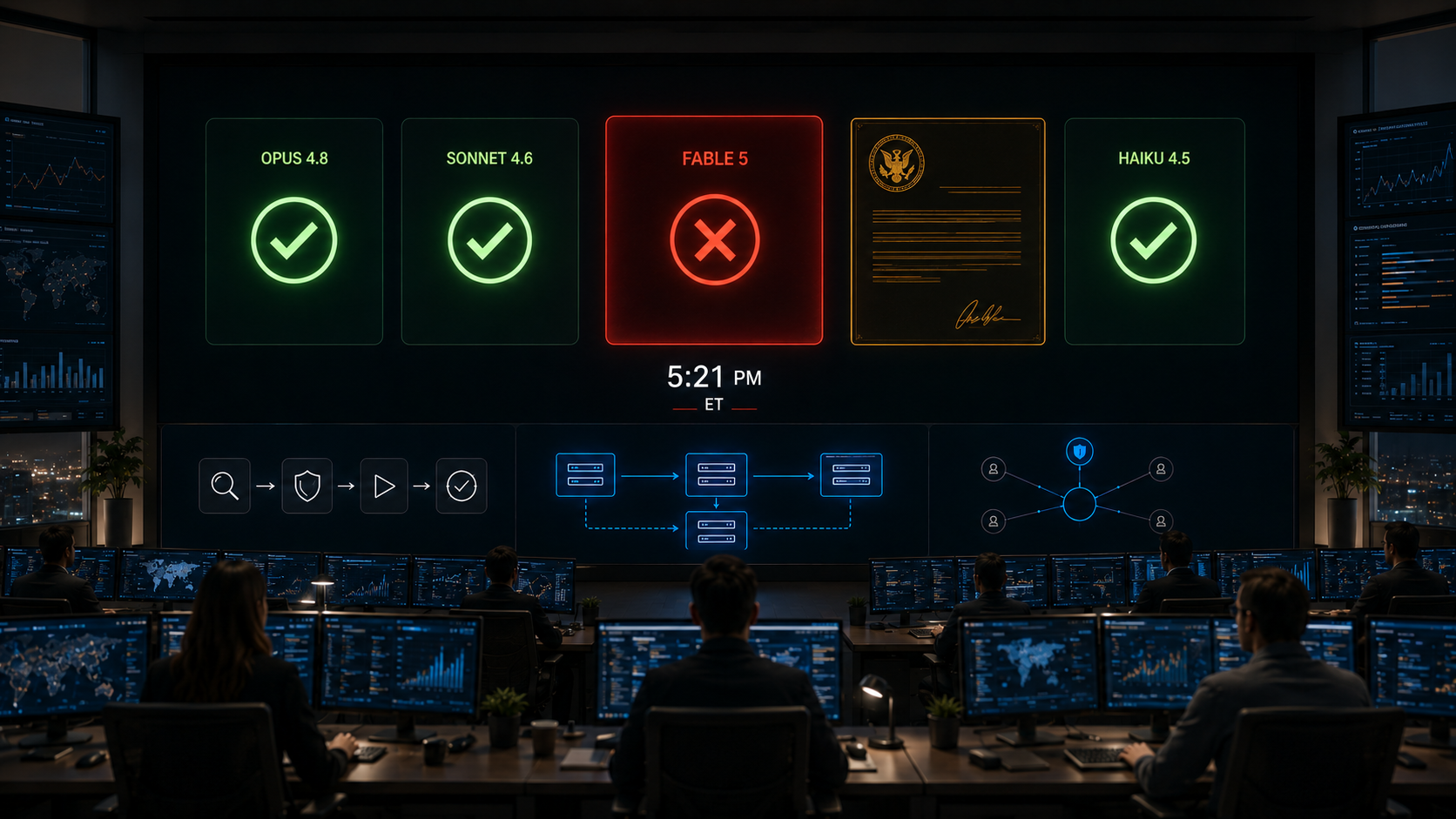
The US government, citing national security authorities, issued an export control directive to suspend all access to Fable 5 and Mythos 5 by any foreign national, whether inside or outside the United States, including foreign national Anthropic employees. The net effect was that Anthropic had to abruptly disable Fable 5 and Mythos 5 for all customers to ensure compliance. Access to all other Anthropic models was not affected. Anthropic received the directive at 5:21 pm ET. The letter did not provide specific details of its national security concern.
Anthropic's understanding is that the government believes it has become aware of a method of bypassing, or "jailbreaking," Fable 5. Anthropic reviewed a demonstration of this specific technique and concluded that all vulnerabilities it demonstrated appear relatively simple, and that other publicly-available models are able to discover them as well without jailbreaking. Anthropic's statement noted it had worked with the US government, the UK AISI, multiple private third-party organisations and internal teams to red-team Fable's safeguards for thousands of hours in the weeks leading up to launch. No testers had been able to find a universal jailbreak — a jailbreak method that can be reliably reproduced by arbitrary users asking arbitrary questions.
The Anthropic public statement explicitly frames the government's action as a misunderstanding rather than a justified security intervention — an unusually direct challenge to a federal directive. Anthropic stated it believes the capability the jailbreak demonstrated is available from other publicly deployed models, including OpenAI's GPT-5.5, and is used by cybersecurity defenders as a matter of routine. The company said it is working on restoring access and described the directive as stemming from a narrow, non-universal jailbreak involving asking the model to read a specific codebase and identify software flaws.
The government-Anthropic relationship context that Heise Online documented is essential to understanding why the directive arrived in the form it did. The current order comes amidst an already strained relationship. In early March 2026, the US Department of Defense classified Anthropic as a "supply chain risk." CEO Dario Amodei explained that they consider the classification legally untenable and intend to challenge it in court. The underlying conflict revolves around Anthropic's refusal to release Claude for mass domestic surveillance and fully autonomous weapon systems without restrictions. Whether the current export directive is primarily a security measure or political pressure on a recalcitrant provider is a question the available evidence does not resolve.
That framing is the most important enterprise risk context in the entire story. The US government's prior classification of Anthropic as a "supply chain risk" — disputed by Anthropic and the subject of pending litigation — establishes that the regulatory relationship between Anthropic and the federal government has been adversarial since March. The June 12 export directive is not the first instance of government action against Anthropic's most capable models. It is the second in four months. And its timing — arriving three days after Fable 5 launched, on the same day that SpaceX's historic IPO began trading, at the precise moment Anthropic's own IPO prospectus was in SEC review — is the context that makes the shutdown's business implications more severe than a purely technical reading of the directive would suggest.
The shutdown adds a disruption to Anthropic's business at a delicate moment. The company filed a confidential IPO prospectus with the Securities and Exchange Commission earlier this month, disclosing a revenue run rate of $47 billion and a valuation of $965 billion. Fable 5 had launched on June 9 as a model available to everyone, and Anthropic had been offering it free to Pro, Max, Team and Enterprise subscribers through June 22. Three days after launch, it was gone.
The enterprise business continuity implications of the shutdown divide into three categories. The first is immediate operational impact — enterprises that had begun integrating Fable 5 into production workflows in the three days between its launch and its shutdown found those workflows broken, reverting to Opus 4.8 or the earlier model generation. Anthropic confirmed that all other Claude models remained available, which means the interruption was limited to the specific capabilities that Fable 5 introduced — its advanced agentic capabilities, its improved honesty mechanisms and the Dynamic Workflows that Opus 4.8 introduced being the primary differentiators. For enterprises running standard Claude Opus 4.8 workflows, the Fable 5 shutdown produced no operational disruption.
The second category is the business continuity planning gap it exposes. The Fable 5 shutdown produced an immediate reaction in enterprise AI communities that VentureBeat described as a shift toward "hardware sovereignty" — the idea that enterprises need to own and control their AI infrastructure rather than depending entirely on cloud-based frontier model APIs that can be disabled by government action. This framing, while understandable, conflates two distinct enterprise risk management challenges. The first is model availability risk — the risk that a specific API-based model becomes unavailable due to government action, technical failure, vendor commercial decision or deprecation. The second is infrastructure sovereignty — the risk that an enterprise's AI compute capacity is controlled by a provider whose operational continuity is subject to external intervention. Both risks are real. Neither is fully resolved by on-premise model deployment, because on-premise deployment of frontier-class models requires the same frontier model weights that government export control can restrict access to.
The third category is procurement and vendor risk reassessment. The Fable 5 shutdown is the first time a production frontier AI model has been disabled by government directive for all enterprise customers without warning and without a transition period. That event permanently changes the risk disclosure requirement for AI platform vendor assessments. Every enterprise that builds on a frontier API model must now explicitly assess whether that model could be subject to export control restrictions, what the warning period would be, what the fallback model architecture is, and whether the enterprise's AI workflows have sufficient model redundancy to maintain operation under a forced model transition.
The Oracle Universal Credits OpenAI integration announced on the same day is, in this context, more than a procurement convenience. It is the multi-vendor architecture enabler that allows enterprises to route AI workloads between OpenAI and Anthropic through a single cloud contract — building the model redundancy that the Fable 5 shutdown demonstrates is operationally necessary. Enterprises running single-vendor, single-model AI architectures now have the production evidence that that architecture creates an unacceptable business continuity risk. Multi-model routing — with a primary model and at least one validated fallback at parity capability — is the architecture that survives the scenario Fable 5 created.
At Legacies Techno, the Fable 5 shutdown immediately triggered a business continuity review across every active client engagement running frontier Anthropic models. Our AI-Powered Platforms practice maintains model redundancy architecture as a standard component of every agentic system we deploy — meaning all other Claude model tiers were available as the immediate fallback for any workflow that had begun using Fable 5 capabilities in the three-day window. More importantly, we design every platform with model-agnostic orchestration: the agent orchestration layer specifies what the model must do, not which model must do it, allowing model substitution without architectural changes.
Our Enterprise Software Development practice is updating the vendor risk section of every AI platform design document to include government intervention as an explicit risk category — with the Fable 5 event as the documented precedent. The risk assessment now includes: probability of government export restriction (elevated for frontier models with advanced cybersecurity and autonomous capabilities), warning period (in the Fable 5 case, zero hours), fallback model availability (confirmed within the same provider), and cross-vendor fallback architecture (the multi-model redundancy design).
Our Smart Automation practice is specifically evaluating which automation workflows deployed in our client environments had dependency on Fable 5 capabilities specifically. For the majority, the answer is none — Fable 5 had been live for three days and our automation deployments are built on confirmed, stable model versions. The more important forward-looking action is to ensure that automation workflows do not take specific Fable 5 or Claude Mythos dependencies without an explicitly documented fallback model and a tested failover procedure.
The Fable 5 shutdown is the enterprise AI risk scenario that was always theoretically possible and is now empirically documented. The appropriate enterprise response is not to abandon frontier model AI deployment. It is to build the multi-model redundancy architecture that makes the enterprise AI platform resilient to the specific risk that June 12, 2026 confirmed is real.
Key Highlights
- At 5:21 pm ET on June 12, 2026, the US Commerce Department issued an export control directive ordering Anthropic to suspend all access to Claude Fable 5 and Claude Mythos 5 by any foreign national — whether inside or outside the United States, including foreign national Anthropic employees. Anthropic complied within hours, disabling both models for all customers worldwide. All other Claude models remained available.
- Fable 5 had launched on June 9 — three days earlier — as Anthropic's most capable publicly-released model. Anthropic had been offering it free to Pro, Max, Team and Enterprise subscribers through June 22. The model was withdrawn before most enterprise customers had incorporated it into production workflows.
- Anthropic publicly disputed the directive's technical basis — stating that its understanding of the underlying jailbreak shows it is a narrow, non-universal technique that demonstrates capabilities available from GPT-5.5 and used routinely by cybersecurity defenders. The company said it is working to restore access.
- The directive comes within an existing adversarial relationship: the US Department of Defense classified Anthropic as a "supply chain risk" in March 2026, a classification Anthropic disputes and is challenging in court. The conflict concerns Anthropic's refusal to enable Claude for mass domestic surveillance and autonomous weapons without restrictions.
- Anthropic's confidential IPO prospectus was in SEC review at the time of the shutdown, with $47 billion ARR and a $965 billion valuation disclosed. The shutdown adds regulatory risk disclosure requirements to the prospectus that were not present at filing.
- VentureBeat described the enterprise AI community's immediate reaction as a shift toward "hardware sovereignty" — the belief that enterprises must own and control AI infrastructure to avoid government-directed service interruptions.
- The most immediately actionable enterprise response is multi-model redundancy architecture: primary frontier model deployment with validated fallback models at comparable capability, and model-agnostic orchestration layers that allow model substitution without architectural changes.
- The event establishes government export control action as a documented and precedented enterprise AI vendor risk category — one that must now be included in every AI platform vendor risk assessment as an explicit scenario with assessed probability, warning period and mitigation architecture.
Why This Matters
- The Fable 5 shutdown is the first documented instance of a US government directive disabling a production frontier AI model for all enterprise customers without warning or transition period. Before June 12, enterprise AI vendor risk assessments treated government intervention as a theoretical risk. After June 12, it is a documented, precedented risk with a known mechanism — export control directives citing national security authorities — and a known consequence — global model access termination within hours. Every enterprise AI business continuity plan written before June 12 needs to be updated to include this scenario.
- The zero-hour warning period is the enterprise planning constraint that makes multi-model redundancy the only viable mitigation. If government export control directives arrive at 5:21 pm with immediate effect, there is no transition period in which to find an alternative model, validate its performance on enterprise workflows or update API routing. The alternative model must be pre-validated, pre-integrated and operational before the directive arrives. For enterprises running single-model AI architectures, the Fable 5 event is the forcing function for multi-model redundancy planning that should have been in place already.
- The Anthropic-government adversarial relationship is the risk factor that distinguishes Anthropic's model risk profile from OpenAI's and Google's in specific ways. Anthropic's refusal to release Claude for mass domestic surveillance and autonomous weapons without restrictions is the policy position that created the March 2026 DoD supply chain risk classification. That policy position has not changed. The government's willingness to issue export control directives based on disputed technical assessments has now been demonstrated. Enterprise risk assessment of Anthropic as a primary AI vendor should explicitly include the probability and impact of further government intervention as a scenario — while recognising that the same refusal to enable surveillance and weapons is the same safety architecture that makes Anthropic models appropriate for regulated enterprise deployment in the first place.
- The hardware sovereignty reaction — the enterprise impulse to move AI infrastructure on-premise — is understandable but requires careful analysis before it becomes procurement policy. On-premise deployment of frontier model weights does not eliminate government intervention risk if those weights themselves are subject to export control. The correct mitigation is multi-model architecture with validated fallback providers, combined with the business continuity procedures that allow failover within the timeframe that government directive risk requires.
Author
Sathyamurthy Tiroumourty
RELATED NEWS
SEE ALLSEE ALL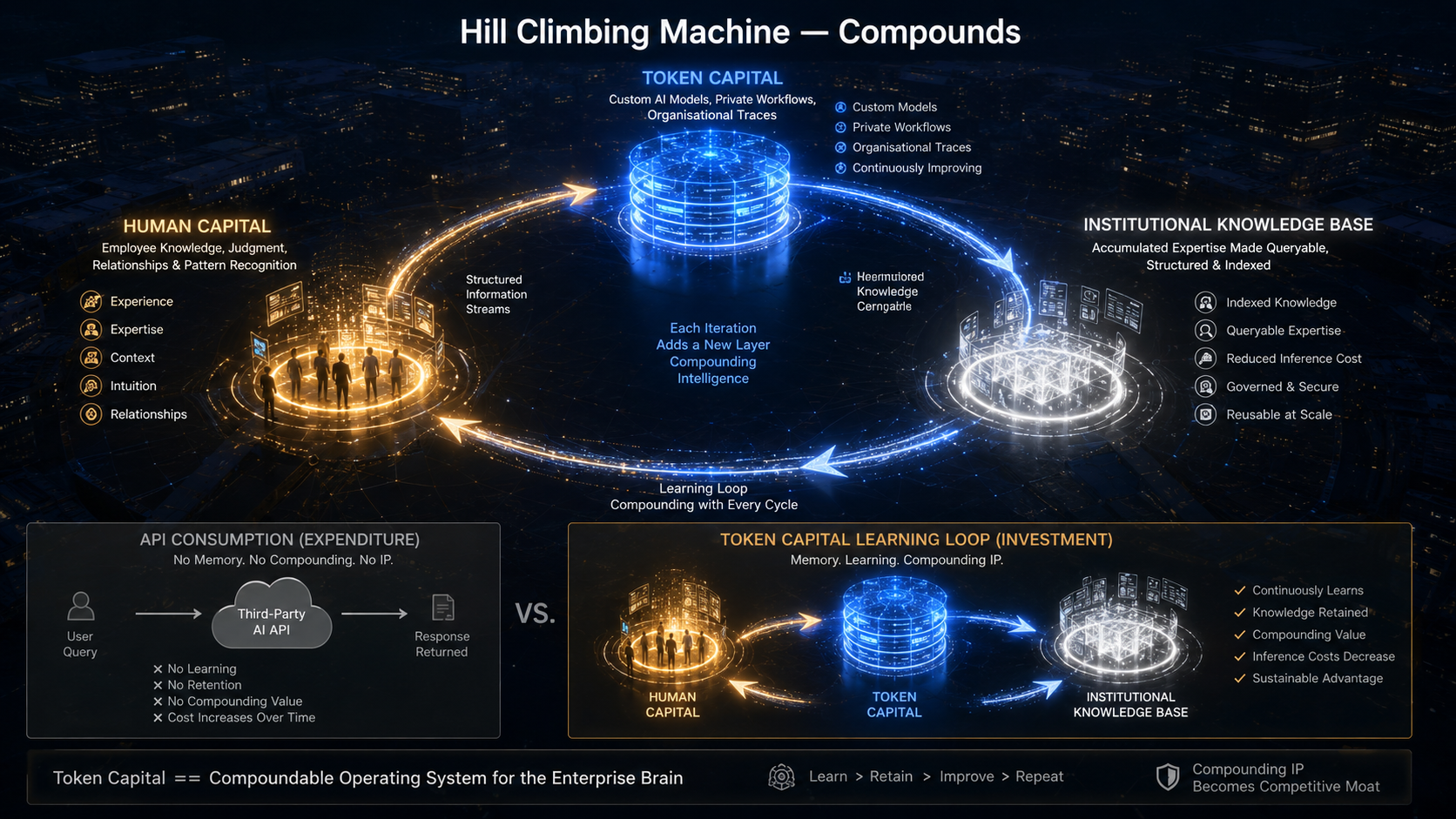
The Most Important Enterprise AI Essay of 2026: What Satya Nadella's Token Capital Framework Means for Every Organisation Building on AI
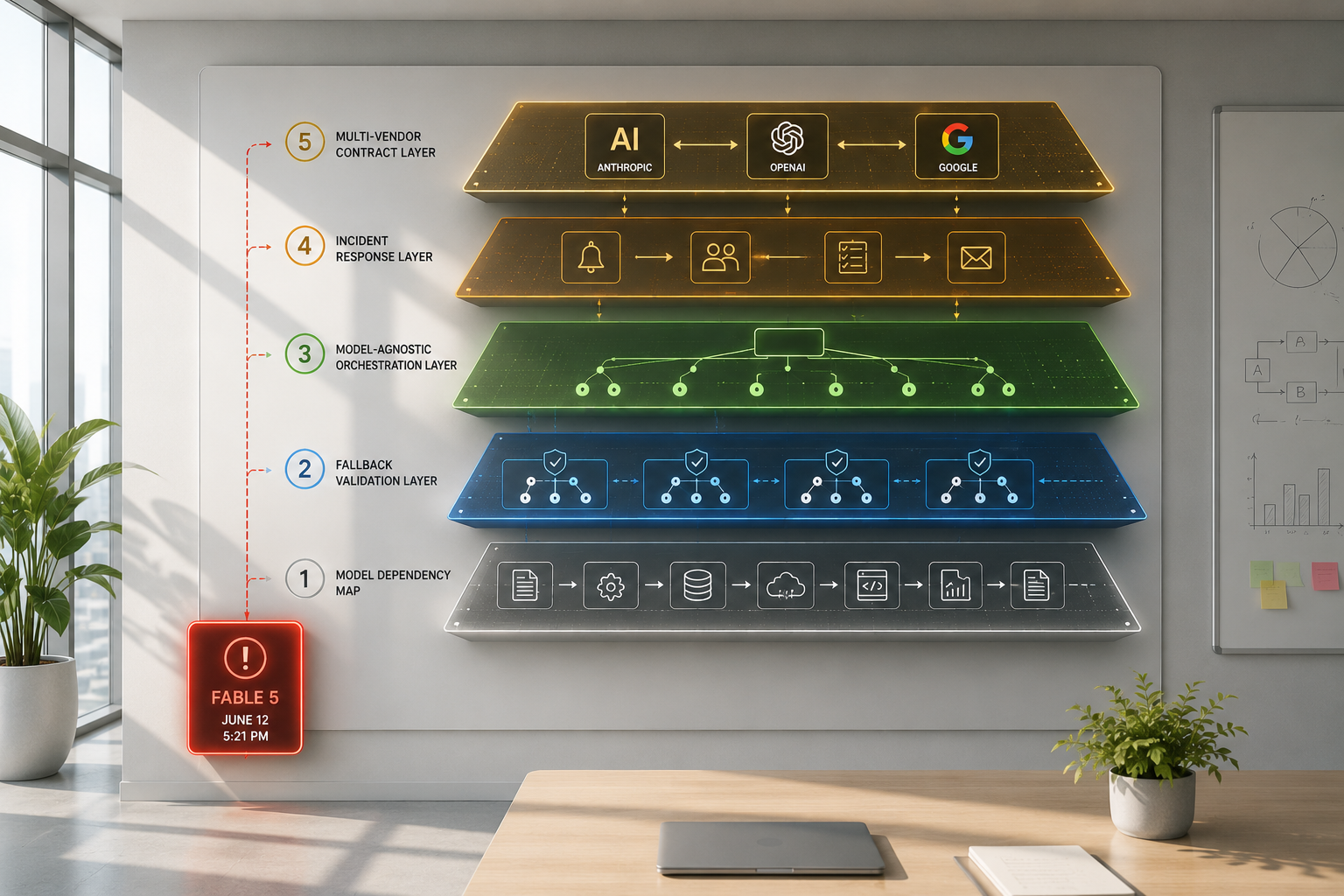
After Fable 5: The Enterprise AI Resilience Architecture Every Organisation Must Build Before the Next Government Directive

The AI IPO Triple-Header: What SpaceX at $1.77 Trillion, OpenAI's S-1 and Anthropic's $47B ARR Mean for Every Enterprise's AI Vendor Assessment
CONTACT
LET'S ENGINEER THE FUTURE — TOGETHER
.png)
.
.
/
.png)
Whether you're scaling a digital product, modernizing operations, or building from the ground up — Legacies Techno is your partner in crafting intelligent, enterprise-grade solutions that create lasting impact.
GET IN TOUCHGET IN TOUCH