
The Most Capable Model Ever Released and a $965 Billion Valuation: What Claude Opus 4.8 and Anthropic's $65B Raise Mean for Every Enterprise Building on AI
On May 28, 2026, Anthropic simultaneously launched Claude Opus 4.8 and announced a $65 billion funding round at a $965 billion valuation — making it the most valuable private technology company in history. Opus 4.8 scores 69.2 percent on SWE-Bench Pro, outperforming GPT-5.5 and Gemini 3.1 Pro. It runs at 2.5 times the speed of Opus 4.7 in fast mode. It costs three times less to run. It is four times less likely than its predecessor to let code flaws pass unremarked. And it introduces Dynamic Workflows — a research preview allowing Claude Code to plan and execute hundreds of parallel subagents in a single session, completing codebase-scale migrations across hundreds of thousands of lines of code. At the same $5/$25 per million token pricing. One week later, on June 2, Anthropic filed confidential draft IPO paperwork. The company that started with a $100 million seed round three years ago is now twelve weeks away from potentially becoming the most valuable AI company in the public markets. The week that produced both announcements is the most consequential in enterprise AI history since the launch of ChatGPT.
Date
Jun 8, 2026
Category
Technology
Reading Time
7 minutes
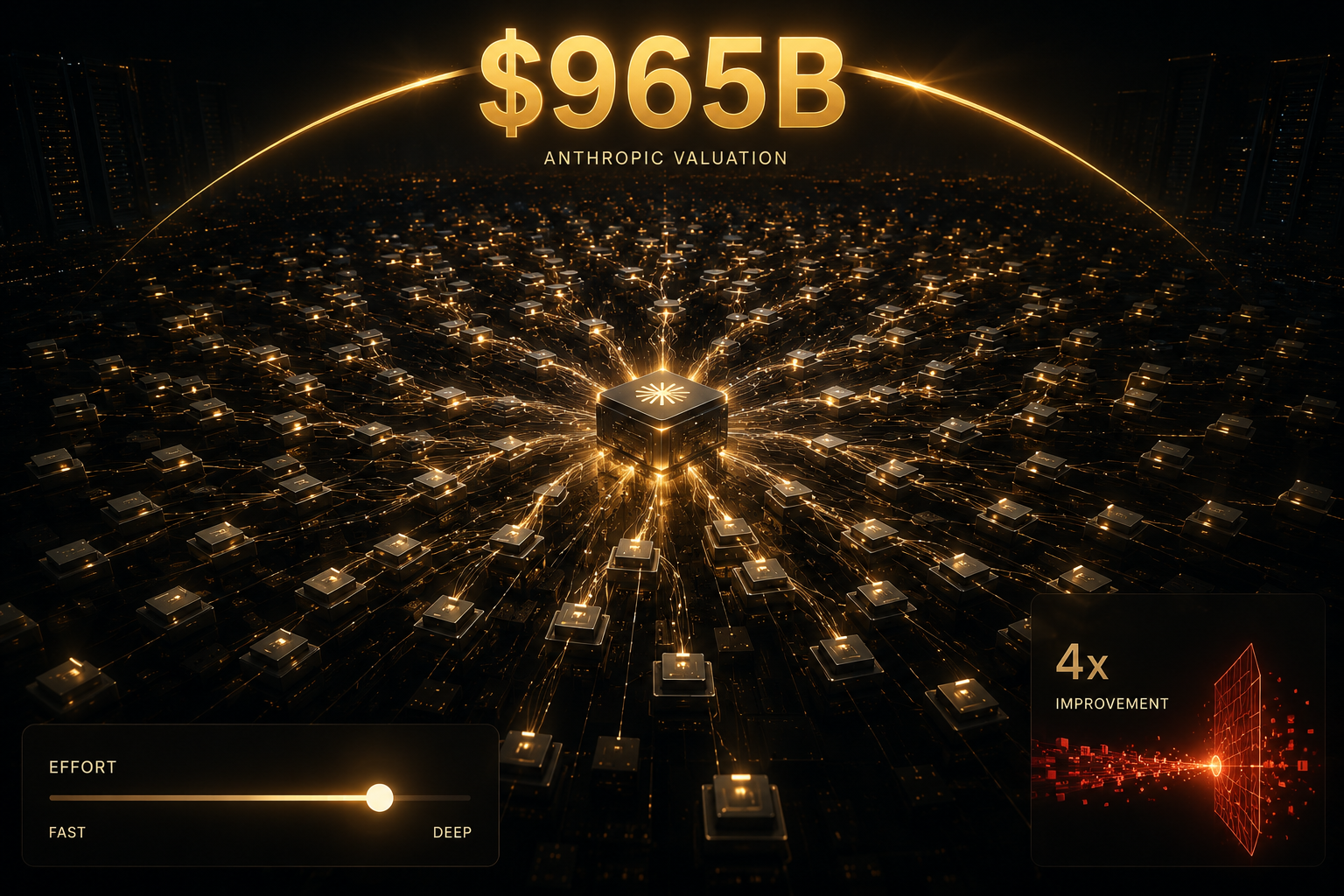
Anthropic has raised $65 billion in new funding at a $965 billion valuation to buy more computing infrastructure. The company introduced Claude Opus 4.8, which scored 74.2 percent on Terminal-Bench 2.1 — a benchmark measuring LLMs' ability to perform tasks in the command line — an 8.4 percent improvement over Opus 4.7. The model scored 4.9 percent higher than Opus 4.7 on SWE-Bench Pro.
The $65 billion raise at a $965 billion valuation is the financial event that places Anthropic in a category no private technology company has previously occupied. For context: $965 billion exceeds the combined market capitalisations of JPMorgan Chase and Bank of America. It exceeds the GDP of the Netherlands. The raise was not announced with a new product or a strategic pivot. It was announced alongside a model release — the clearest possible signal that Anthropic's investors are valuing the company on the premise that its model capability is the business, and that the business is worth almost a trillion dollars at current revenue and trajectory.
Anthropic claims Claude Opus 4.8 is a more effective collaborator with improvements in agentic coding, multidisciplinary reasoning, agentic computer use, knowledge work and agentic financial analysis. Testers have found Opus 4.8 to be more reliable and sharper in its judgement when doing agentic tasks, and the model made gains in honesty. Early testers report that Opus 4.8 is more likely to flag uncertainties about its work and less likely to make unsupported claims.
The honesty improvement is the enterprise dimension that benchmarks cannot fully capture but that enterprise production experience makes the clearest differentiator. An AI agent that runs hundreds of parallel subagents across a codebase migration will encounter edge cases, ambiguous requirements and situations where it has incomplete information. The predecessor model's tendency to allow flaws to pass unremarked — proceeding through uncertainty rather than flagging it — creates downstream errors that require more human time to identify and correct than the original automation saved. Anthropic's evaluations show that Opus 4.8 is around four times less likely than its predecessor to allow flaws in code it has written to pass unremarked. Alignment assessments suggest the model hits new highs on measures of prosocial traits including supporting user autonomy and acting in the user's best interest.
The Dynamic Workflows feature is the capability that changes what enterprise AI coding deployments can attempt. Dynamic workflows — available in research preview — allow Claude to complete bigger tasks in Claude Code. It is able to plan work and run hundreds of parallel subagents in a single session. It is able to complete codebase-scale migrations across hundreds of thousands of lines of code. The feature is available for Claude Code for Enterprise, Team and Max plans. The significance of hundreds of parallel subagents in a single session is not primarily speed — it is task class. A sequential agent can complete a large coding task given enough time. A parallel swarm can complete task classes that sequential agents cannot — tasks where multiple independent workstreams must be evaluated simultaneously, cross-referenced against each other and synthesised into a consistent output. Codebase-scale migrations that require consistent transformation of a million lines of code across dozens of interdependent modules are the paradigm case. The parallel subagent architecture is what makes that task class automatable rather than merely accelerated.
Opus 4.8's fast mode runs at 2.5 times the speed of Opus 4.7, and the model is three times cheaper than prior models. The pricing context for this claim requires precision: the $5/$25 per million token base pricing is unchanged from Opus 4.7. The three times cheaper claim refers to the effective cost per unit of completed work — because Opus 4.8's improvements in reasoning efficiency and task completion accuracy mean that the same enterprise workflow consumes fewer tokens and requires less human-in-the-loop correction overhead than the equivalent Opus 4.7 deployment. The real cost reduction is not in the per-token price but in the per-outcome cost when better model judgment reduces the rework that prior model generations required.
Effort Control — the second major product addition alongside Dynamic Workflows — addresses a different dimension of enterprise AI deployment: the variability between different types of enterprise tasks. In Claude.ai and Cowork, users can choose how much effort Claude puts into a response. With a lower setting, Claude will respond faster and use up rate limits more slowly. For enterprise deployments where some requests require the full reasoning depth of Opus 4.8 and others can be handled with lighter processing — a quick email summary versus a complex legal document analysis — Effort Control gives enterprise users the throttle mechanism that makes the model's capability configurable to the task rather than fixed at the maximum. This is the enterprise equivalent of the multi-tier model routing architecture that our practice has been recommending: within a single model deployment, different tasks can now be assigned different effort levels with the same governance and security controls applied to all of them.
The confidential IPO filing on June 2 transforms Anthropic from a private company making strategic decisions under investor governance to a company preparing for the public market accountability that IPO filing imposes. Anthropic filed confidential draft IPO paperwork as SEC review began on June 2, 2026. The confidential filing is the standard pre-IPO mechanism that allows companies to test the regulatory process without public disclosure of financials until thirty days before the roadshow. The SEC review period typically takes four to eight weeks, which places the potential public prospectus disclosure in late July to early August 2026, with a roadshow and listing potentially in September or October 2026.
The IPO implications for enterprise procurement are the dimension that has received the least analysis in the coverage of the May 28 announcement. An Anthropic that completes a public listing in October 2026 is a fundamentally different vendor relationship for every enterprise that has signed a multi-year Claude contract or built production AI architecture on Anthropic's models. Public company governance brings audited financials, quarterly reporting obligations, independent board oversight, transparency requirements and a shareholder accountability structure that makes long-term vendor reliability assessments more tractable. The enterprises that have been cautious about committing to Anthropic as a primary AI vendor because of private company opacity will have a public financial record to evaluate before the end of 2026.
At Legacies Techno, Claude Opus 4.8's Dynamic Workflows capability is the most operationally significant addition to the production AI architecture available to enterprise engineering teams this month. Our Enterprise Software Development practice has been building multi-agent coding architectures for codebase analysis, legacy modernisation and test coverage initiatives — and the Dynamic Workflows parallel subagent capability is the infrastructure that makes the largest-scale versions of those initiatives executable in a single Claude Code session rather than requiring custom multi-agent orchestration frameworks built on top of the model layer.
Our AI-Powered Platforms practice is specifically evaluating the Effort Control feature for agentic system deployments where the effort profile of different request types varies significantly. The ability to configure effort at the request level — within a single governed deployment with consistent security and audit controls — is the capability that closes the gap between a fine-grained multi-tier model routing architecture and the simpler governance of a single-model deployment. For enterprise clients that have been managing model routing complexity, Effort Control is worth evaluating as a simplification pathway.
Our Smart Automation practice is assessing the 4x improvement in code flaw flagging against the specific automation deployment risk profile it addresses: AI-generated code that proceeds through production with undetected errors creates a specific class of automation failure — not an agent that crashes visibly but one that produces subtly incorrect outputs that require human investigation to identify. The 4x reduction in silent flaw propagation is the reliability improvement that most directly reduces the human oversight overhead required for high-volume, AI-generated automation code in production.
Claude Opus 4.8 is Anthropic's most capable model. The $65 billion raise at $965 billion is the market's valuation of that trajectory. Dynamic Workflows is the enterprise capability that makes codebase-scale AI deployment a production option rather than an experimental initiative. The IPO filing is the governance transition that makes Anthropic a more assessable vendor. Every enterprise making AI platform decisions in June 2026 has more information, more capability and more vendor stability certainty than at any prior point. The decisions made this quarter will compound through the decade.
Key Highlights
- Anthropic simultaneously launched Claude Opus 4.8 and raised $65 billion at a $965 billion valuation on May 28, 2026 — the highest valuation in private technology company history and the most consequential single day in Anthropic's history.
- Opus 4.8 scores 69.2 percent on SWE-Bench Pro — outperforming both GPT-5.5 and Gemini 3.1 Pro on that benchmark — and 74.2 percent on Terminal-Bench 2.1, an 8.4 percent improvement over Opus 4.7. Pricing is unchanged at $5/$25 per million tokens.
- The model runs at 2.5x the speed of Opus 4.7 in fast mode and is three times cheaper per unit of completed work through improved reasoning efficiency and reduced rework requirements.
- Opus 4.8 is four times less likely than Opus 4.7 to allow code flaws to pass unremarked — proactively flagging uncertainties and declining to make unsupported claims. Alignment assessments show new highs on prosocial measures including supporting user autonomy and acting in the user's best interest.
- Dynamic Workflows (research preview, Claude Code Enterprise/Team/Max plans): Claude can plan work and run hundreds of parallel subagents in a single session, completing codebase-scale migrations across hundreds of thousands of lines of code — enabling task classes that sequential agents cannot address.
- Effort Control (Claude.ai and Cowork): users can configure how much effort Claude applies to a response, enabling faster, lower-rate-limit processing for lighter tasks within a single governed deployment.
- Anthropic filed confidential draft IPO paperwork on June 2, 2026, beginning the SEC review process. The timeline suggests a potential public prospectus disclosure in late July to early August, with a roadshow and listing potentially in September-October 2026.
- The $65B raise was led by existing investors including Google, Spark Capital, Salesforce Ventures and General Catalyst. The round brings Anthropic's total funding to over $75 billion since its founding.=
Why This Matters
- The $965 billion valuation is the market's assessment of Anthropic's trajectory — not its current revenue. The valuation implies that investors with full access to Anthropic's financials, pipeline and model roadmap believe the company is on track to generate revenue consistent with a near-trillion-dollar enterprise value. For enterprise procurement teams evaluating AI vendor stability, the $65B raise at $965B is the strongest possible financial signal that Anthropic has secured the capital to fund its model development and infrastructure buildout through the remainder of this decade.
- Dynamic Workflows' parallel subagent architecture is the capability that should prompt every enterprise engineering team to re-evaluate which task categories they have classified as "too complex for AI automation." The previous constraint on AI-assisted coding was sequential execution — one agent, one workstream, limited by how much context a single session could maintain. Hundreds of parallel subagents per session eliminates that constraint for many of the largest, most valuable engineering tasks on every enterprise's backlog. Legacy modernisation at scale, comprehensive test suite generation across large codebases, and systematic API migration projects are all candidates for Dynamic Workflows re-evaluation.
- The 4x improvement in proactive flaw flagging is the production reliability advance that changes the risk calculus for unsupervised agentic coding deployment. The primary reason enterprise engineering teams have maintained human review checkpoints in AI-assisted coding pipelines is not lack of confidence in the model's ability to write code — it is lack of confidence in the model's ability to detect its own errors. A model that is four times more likely to flag its own uncertainties is a model that can be trusted with a larger autonomous execution boundary without increasing the error rate that human reviewers must catch.
- The confidential IPO filing on June 2 is the vendor relationship change that every enterprise legal and procurement team should have noted. Anthropic moving through the public listing process creates a transparency trajectory that improves enterprise vendor assessment capability with each SEC filing. Enterprises that have been maintaining vendor diversity strategies partly to hedge against private-company opacity will have an Anthropic public financial record to evaluate before the end of this year.
Author
Legacies Engineering
RELATED NEWS
SEE ALLSEE ALL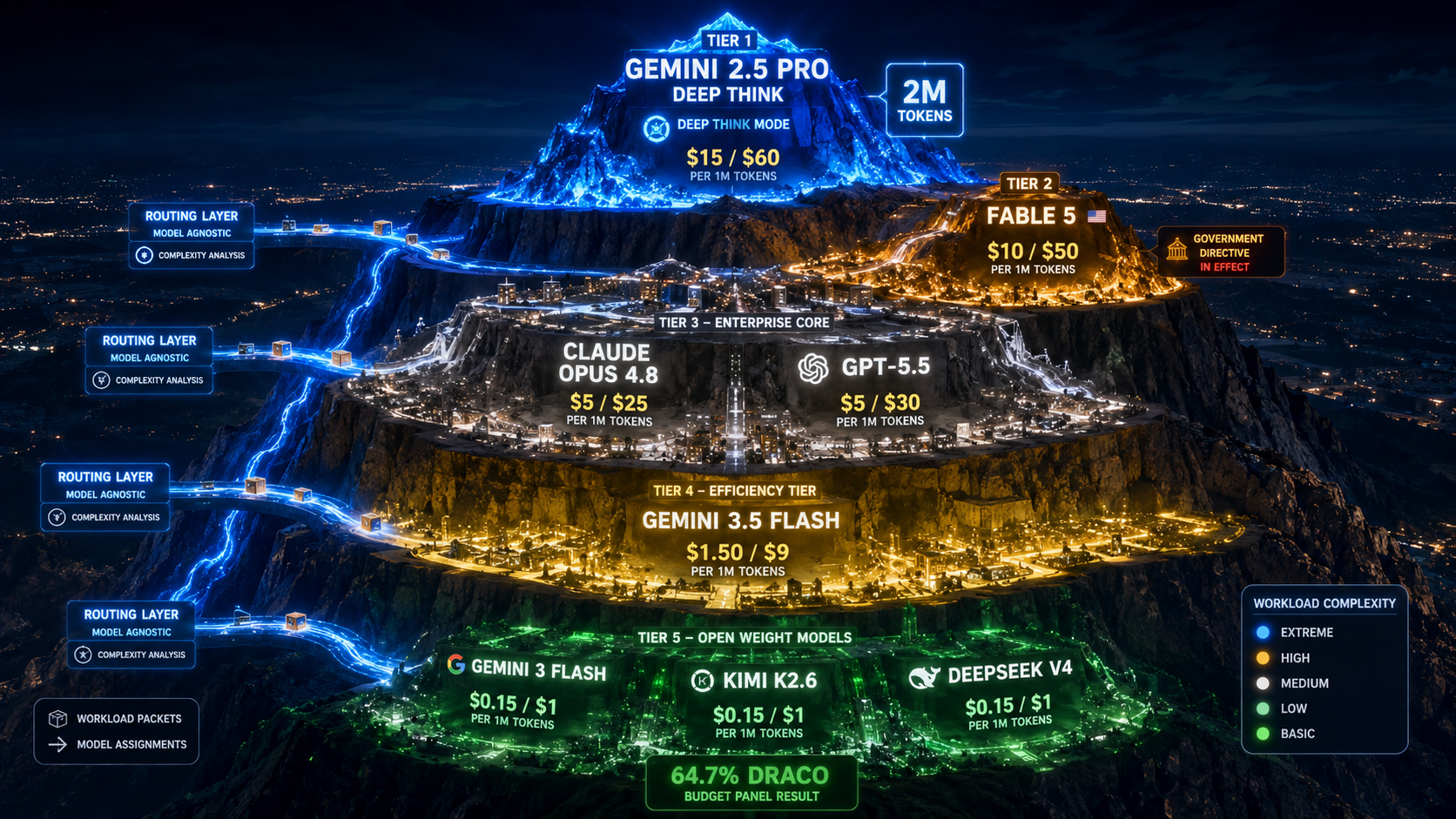
The Frontier Model Market Just Restructured Overnight: What Gemini 2.5 Pro Deep Think, Fable 5's Billing Cliff and the OpenRouter Fusion Data Mean for Every Enterprise AI Architecture

Apple's Last Act and Its Biggest AI Bet: What WWDC 2026, Siri AI and iOS 27 Mean for Every Enterprise in Apple's Ecosystem
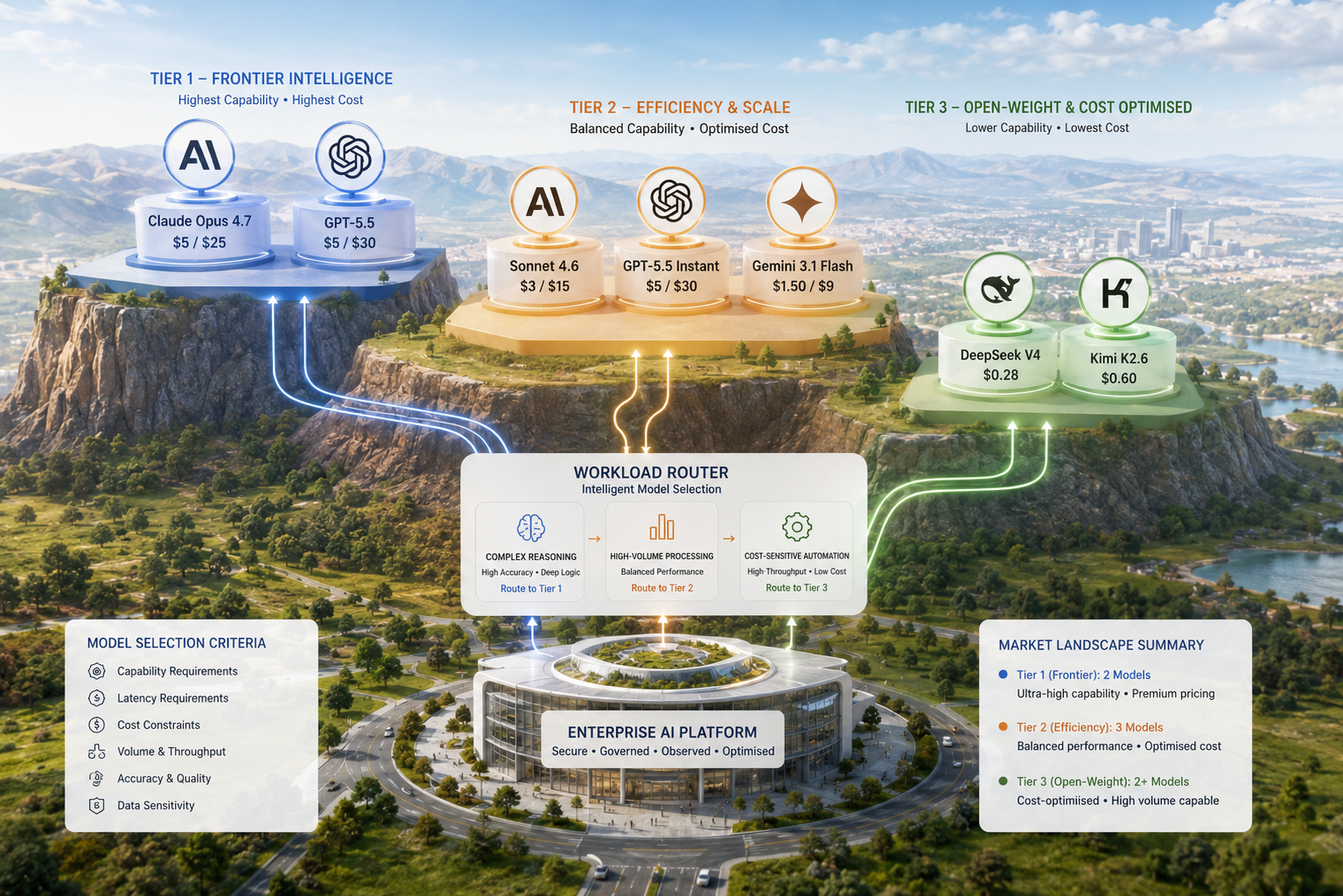
What OpenAI Actually Shipped in May and Where the Frontier Model Market Stands Heading Into June
CONTACT
LET'S ENGINEER THE FUTURE — TOGETHER
.png)
.
.
/
.png)
Whether you're scaling a digital product, modernizing operations, or building from the ground up — Legacies Techno is your partner in crafting intelligent, enterprise-grade solutions that create lasting impact.
GET IN TOUCHGET IN TOUCH