
What OpenAI Actually Shipped in May and Where the Frontier Model Market Stands Heading Into June
OpenAI shipped more AI infrastructure and product capability in May 2026 than it has in any prior month — and it did so with almost no major press events. GPT-5.5 Instant replaced GPT-5.3 as the default model across every ChatGPT tier on May 5. Codex CLI received Goal Mode, transforming it into a persistent autonomous agent runtime rather than a single-session coding tool. ChatGPT for Excel reached general availability. A GPT-5.6 model string briefly appeared in Codex logs — consistent with active backend canary testing. And the frontier model market heading into June looks substantially different from the one that opened April: GPT-5.5 at $5/$30 per million tokens, Claude Opus 4.7 at $5/$25 per million tokens, Gemini 3.1 Flash at $1.50/$9 per million tokens and Chinese open-weight alternatives at a fraction of all three. Every enterprise engineering team managing an AI platform decision for Q3 needs the complete picture.
Date
May 29, 2026
Category
Technology
Reading Time
7 minutes
There is a pattern in how OpenAI ships product that makes its May changelog more consequential than its press conference cadence suggests. The model launches get the announcement events — GPT-5.5 launched April 23 with Greg Brockman calling it a "new class of intelligence." What follows the announcement is a series of capability updates, default changes and tooling releases that collectively change the operational reality of enterprise OpenAI deployments more significantly than the headline launch did. Between April 23 and May 28, 2026, OpenAI shipped GPT-5.5 as the new flagship model, promoted GPT-5.5 Instant to ChatGPT's default across every tier, rolled out ChatGPT for Excel and Google Sheets, and turned Codex CLI into a persistent autonomous agent runtime through four capability updates including Goal Mode.
The GPT-5.5 Instant default change on May 5 is the update most likely to affect enterprise deployments without the affected teams noticing. GPT-5.5 Instant is the new default model for every ChatGPT tier — Free, Go, Plus, Pro, Business, Enterprise and Edu. Paid users can still select GPT-5.3 Instant from model settings for three months before retirement. The model ships at $5 per million input tokens and $30 per million output tokens at standard tier. Enterprise teams that have been using the default ChatGPT model in their workflows — rather than explicitly specifying a model version — have been running GPT-5.5 Instant since May 5 without necessarily knowing it. For organisations that have established performance baselines, cost models or quality benchmarks against the prior default model, an audit of current model usage is the appropriate response to the default change.
GPT-5.5 Instant achieves 52.5 percent fewer hallucinations on high-stakes prompts compared to its predecessor. The hallucination reduction is the performance dimension that matters most for enterprise deployment of AI in workflows involving factual accuracy requirements — regulatory filings, financial analysis, customer communication, medical documentation. A 52.5 percent reduction in hallucination rate on high-stakes prompts is not a marginal improvement. For workflows where a hallucination creates downstream consequences — a regulatory submission with an incorrect citation, a financial calculation based on a fabricated number — the hallucination rate is the primary model selection criterion, and a 52.5 percent reduction makes GPT-5.5 Instant materially more viable for those workflows than GPT-5.3 was.
The Codex CLI Goal Mode update is the most significant enterprise product change in OpenAI's May changelog. Goal Mode transforms Codex CLI from a single-session tool that completes one coding task per invocation into a persistent autonomous agent runtime that maintains context across sessions, plans multi-step workflows, delegates sub-tasks and adapts its approach based on outcomes rather than executing a fixed sequence of steps. OpenAI turned Codex CLI into a persistent autonomous agent runtime through four capability updates, making it capable of maintaining engineering context across sessions and executing multi-step workflows autonomously. For enterprise engineering teams that have been using Codex as a developer productivity tool — single-session code generation, file editing, test writing — Goal Mode represents the architectural shift from tool to agent. An agent that maintains context across sessions can take on the class of engineering task that requires multi-day execution: the legacy system analysis that spans thousands of files, the refactoring project that requires understanding dependencies across multiple repositories, the test coverage initiative that requires systematically identifying and closing gaps across a large codebase.
ChatGPT for Excel reaching general availability is the Microsoft 365 integration story that completes the picture OpenAI has been assembling since the Deployment Company announcement. OpenAI rolled out ChatGPT for Excel and Google Sheets. Anthropic's Microsoft 365 add-ins for Excel, PowerPoint and Word also reached general availability — which we covered in the Anthropic Financial Services Briefing blog on May 7. The result as of June 2026 is that both leading AI labs have native integration in Microsoft's productivity stack, bringing frontier model capability to the business users who work in Excel without requiring a context switch to a dedicated AI interface. For enterprise analytics, finance and operations teams, the Excel integration is the distribution mechanism that AI platform adoption has been waiting for — the channel through which enterprise users who are not engineers access frontier model capability in the workflow they already live in.
The GPT-5.6 canary signal is worth naming with appropriate epistemic precision. A Codex log entry briefly referenced GPT-5.6 mid-May, consistent with backend canary testing, but there is no model card, no API endpoint, no benchmarks and no published release date. Polymarket traders give roughly 80 to 89 percent odds of a public release by June 30, 2026. An 80 to 89 percent Polymarket probability represents the collective estimate of a prediction market — not a vendor commitment. Enterprise architecture decisions should be made on confirmed model availability, not prediction market signals. The appropriate enterprise response to the GPT-5.6 canary signal is to note that a next GPT-5.x release is likely within the next 30 days and plan a model evaluation sprint for the week of its announcement, not to defer current production decisions pending its release.
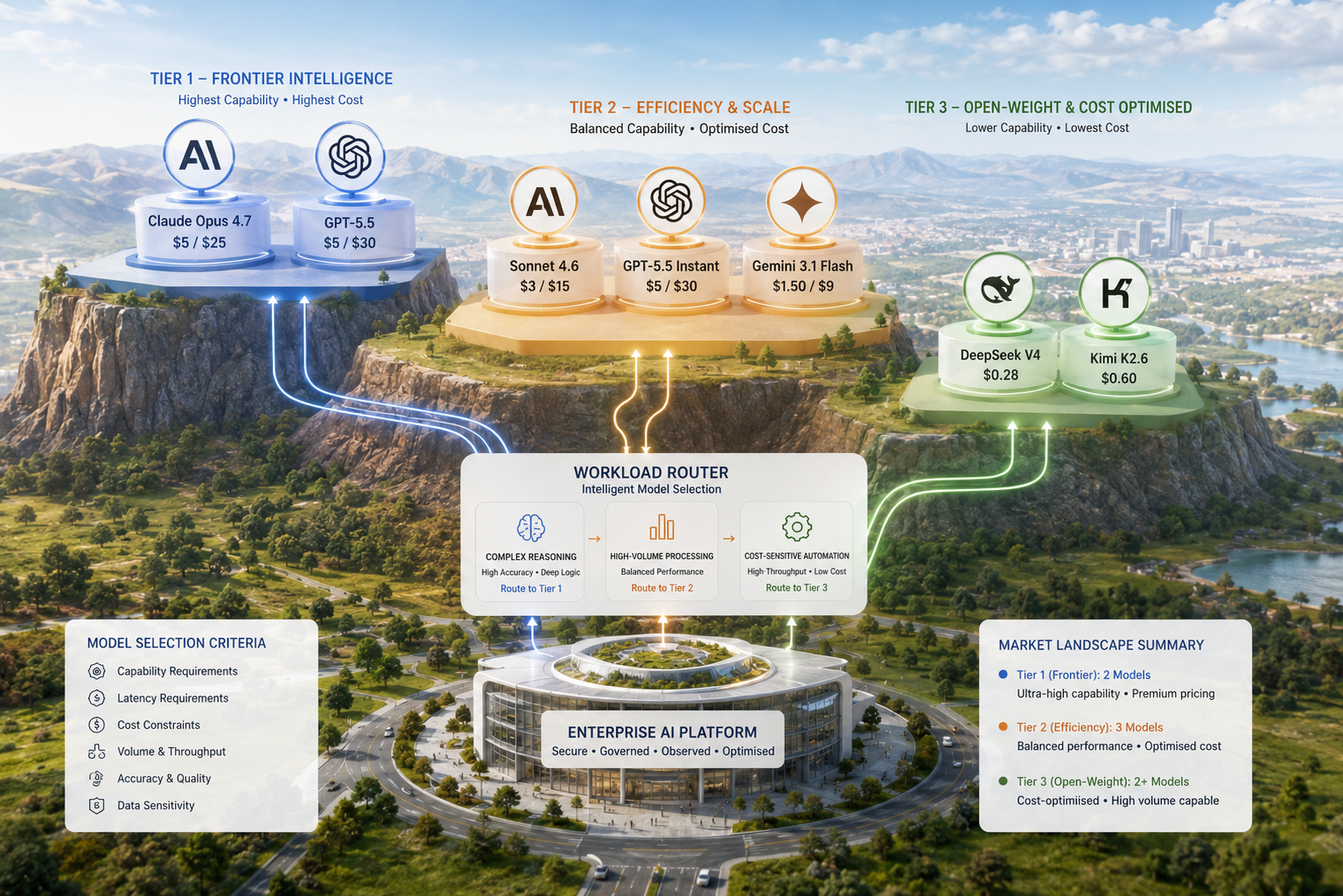
The frontier model market heading into June 2026 deserves a clear-eyed pricing and capability summary because the landscape has shifted significantly since the year opened. As of May 29, the production options for enterprise AI workloads divide into three distinct tiers. The frontier closed-source tier — Claude Opus 4.7 at $5/$25 per million tokens, GPT-5.5 at $5/$30 per million — delivers the highest capability for complex reasoning, long-context work and safety-critical applications. Opus 4.7 holds the SWE-bench Verified lead at 64.3 percent among generally available models; GPT-5.5 scores 88.7 percent on SWE-bench but uses a different evaluation methodology that makes direct comparison contested. Both models support 1 million token context windows and are available across all major cloud providers.
The mid-tier efficiency layer — Claude Sonnet 4.6 at $3/$15, GPT-5.5 Instant at $5/$30, Gemini 3.1 Flash at $1.50/$9 — delivers strong performance for the majority of enterprise use cases at substantially lower inference cost. Gemini 3.1 Flash's pricing is the most disruptive element in the frontier model market as of June 2026: at $1.50 per million input tokens and $9 per million output tokens, it is 3.3 times cheaper on output than Claude Sonnet 4.6 and 3.3 times cheaper than GPT-5.5 Instant. For high-volume enterprise workloads where capability requirements are met by Flash-class performance, the economics of running Gemini 3.1 Flash versus Sonnet 4.6 or GPT-5.5 Instant are material enough to warrant explicit evaluation.
The open-weight cost tier — Chinese models at $0.28 to $3.48 per million output tokens, with DeepSeek V4-Flash at $0.28 and Kimi K2.6 at $0.60 — represents the structural cost disruption we covered in the Chinese open-weight blog on May 12. For enterprise workloads where Chinese model capability is validated against specific deployment requirements and data sovereignty constraints are addressed, the cost differential versus frontier closed-source models is 7 to 90 times depending on the model comparison. The organisations that have designed their AI architecture to route workloads by complexity and compliance requirements rather than running all workloads on a single frontier closed-source model are generating AI infrastructure economics that their competitors cannot match without the same deliberate architecture.
At Legacies Techno, the OpenAI May changelog and the current frontier model market landscape together produce the platform update that our engineering and client teams need heading into June. Our AI-Powered Platforms practice updates its model routing architecture recommendations to reflect the current pricing and capability tiers — and specifically incorporates Gemini 3.1 Flash as the mid-tier efficiency option for high-volume workloads where its pricing advantage is significant and its capability has been validated against specific use case requirements.
Our Enterprise Software Development practice incorporates Codex CLI Goal Mode into the agentic coding architecture recommendations we make to enterprise engineering teams. The shift from single-session tool to persistent agent runtime is the capability threshold at which Codex becomes viable for the long-horizon engineering tasks — legacy modernisation, comprehensive test coverage, multi-repository refactoring — that generate the highest enterprise returns from AI-assisted development. Our practice is evaluating Goal Mode against the production engineering workflows of our current clients to identify which task categories cross the threshold where the persistent agent architecture generates returns that single-session tool usage cannot.
Our Smart Automation practice tracks the ChatGPT for Excel and Anthropic Microsoft 365 add-in general availability as the distribution mechanism for enterprise user-facing AI capability. The automation workflows that generate the highest adoption and the most consistent usage in enterprise environments are the ones that reach users in the tools they already use. Excel integration by both OpenAI and Anthropic in May 2026 is the deployment mechanism that removes the last context-switch barrier for the business analyst, finance professional and operations manager segments — the enterprise user populations where AI adoption has lagged the most and where the productivity potential remains the most untapped.
The frontier model market in June 2026 is more competitive, more diverse and more economically interesting than it has been at any prior point. The organisations that understand the full landscape — closed-source frontier, mid-tier efficiency, open-weight cost tiers — and build deliberate routing architecture across those tiers will compound the cost and capability advantages that architecture generates. The organisations still running a single model for all workloads are paying frontier prices for workloads that do not require frontier capability.
The architecture question is specific, the data is available and the ROI is measurable. June is the right time to act.
Key Highlights
- GPT-5.5 Instant became the default model for every ChatGPT tier on May 5, 2026 — replacing GPT-5.3 across Free, Go, Plus, Pro, Business, Enterprise and Edu. Priced at $5/$30 per million tokens, it delivers 52.5 percent fewer hallucinations on high-stakes prompts compared to its predecessor.
- Codex CLI received Goal Mode — transforming it from a single-session coding tool into a persistent autonomous agent runtime that maintains engineering context across sessions, plans multi-step workflows and adapts based on outcomes. This is the architectural shift that makes Codex viable for long-horizon enterprise engineering tasks.
- ChatGPT for Excel and Google Sheets reached general availability in May, completing a Microsoft 365 integration picture where both OpenAI and Anthropic now have native frontier model capability accessible from within the productivity applications enterprise business users already use.
- A GPT-5.6 model string appeared briefly in Codex logs mid-May — consistent with backend canary testing. Polymarket gives 80 to 89 percent odds of public release by June 30, 2026. No model card, API endpoint or benchmarks are available. Enterprise architecture decisions should be based on confirmed availability, not prediction market signals.
- The frontier model market as of May 29 has three distinct tiers: frontier closed-source (Claude Opus 4.7 at $5/$25, GPT-5.5 at $5/$30); mid-tier efficiency (Sonnet 4.6 at $3/$15, GPT-5.5 Instant at $5/$30, Gemini 3.1 Flash at $1.50/$9); and open-weight cost alternatives (DeepSeek V4-Flash at $0.28, Kimi K2.6 at $0.60 per million output tokens).
- Gemini 3.1 Flash at $1.50/$9 per million tokens is 3.3 times cheaper on output than Claude Sonnet 4.6 and GPT-5.5 Instant. For high-volume enterprise workloads where Flash-class capability is sufficient, the pricing differential is material enough to warrant explicit evaluation.
- OpenAI has 4 million active Codex users, 9 million paying business users on ChatGPT and more than 900 million weekly active users and over 50 million subscribers total — data that accompanied the GPT-5.5 launch and was designed to counter the narrative that OpenAI has lost traction to Anthropic in the enterprise market.
- The complete May 2026 OpenAI changelog was published on May 28, 2026, providing the first comprehensive post-hoc accounting of what shipped between April 23 and May 28 — confirming that the product velocity behind the GPT-5.5 announcement headline was substantially higher than the press event suggested.
Why This Matters
- The GPT-5.5 Instant default change is the May OpenAI update most likely to affect enterprise production deployments without the affected teams knowing it happened. Every enterprise using OpenAI models through the ChatGPT interface rather than explicit API model IDs should audit which model their workflows are currently running — the default changed on May 5 and the enterprise teams that have not noticed should verify their cost and quality baselines against the new default before the GPT-5.3 retirement date.
- Codex CLI Goal Mode is the capability threshold at which AI-assisted software development crosses from productivity tool into autonomous engineering agent. The enterprise engineering tasks with the highest ROI — legacy modernisation, comprehensive test coverage, multi-repository refactoring — require exactly the multi-session persistence, multi-step planning and adaptive execution that Goal Mode provides. Enterprise engineering teams that have evaluated Codex as a single-session tool and found it insufficient for complex tasks should re-evaluate Goal Mode against those same task classes. The tool and the agent are different products.
- Gemini 3.1 Flash's $1.50/$9 pricing is the most disruptive competitive move in the frontier model market as of June 2026. The pricing difference between Flash and Sonnet 4.6 or GPT-5.5 Instant is not a marginal efficiency gain — it is 3.3 times less expensive on output. For enterprise organisations processing high volumes of documents, queries or automated workflow outputs, that cost difference compounds into millions of dollars annually at scale. The enterprises that have modelled their AI infrastructure costs against a single-tier model and have not evaluated Gemini 3.1 Flash for appropriate workloads are overpaying.
- The three-tier frontier model market structure that has fully emerged in June 2026 is the defining economic context for enterprise AI platform architecture decisions in H2 2026. Single-model architectures that pay frontier closed-source prices for all workloads are not maximising AI infrastructure ROI. Multi-tier architectures that route workloads by complexity, compliance and cost requirements generate compound cost efficiency that compounds with every additional workload deployed on the correct model tier. Building that routing architecture is the Q2-Q3 2026 infrastructure investment that pays compound returns through 2028.
Author
Janani Sathyamurthy
RELATED NEWS
SEE ALLSEE ALL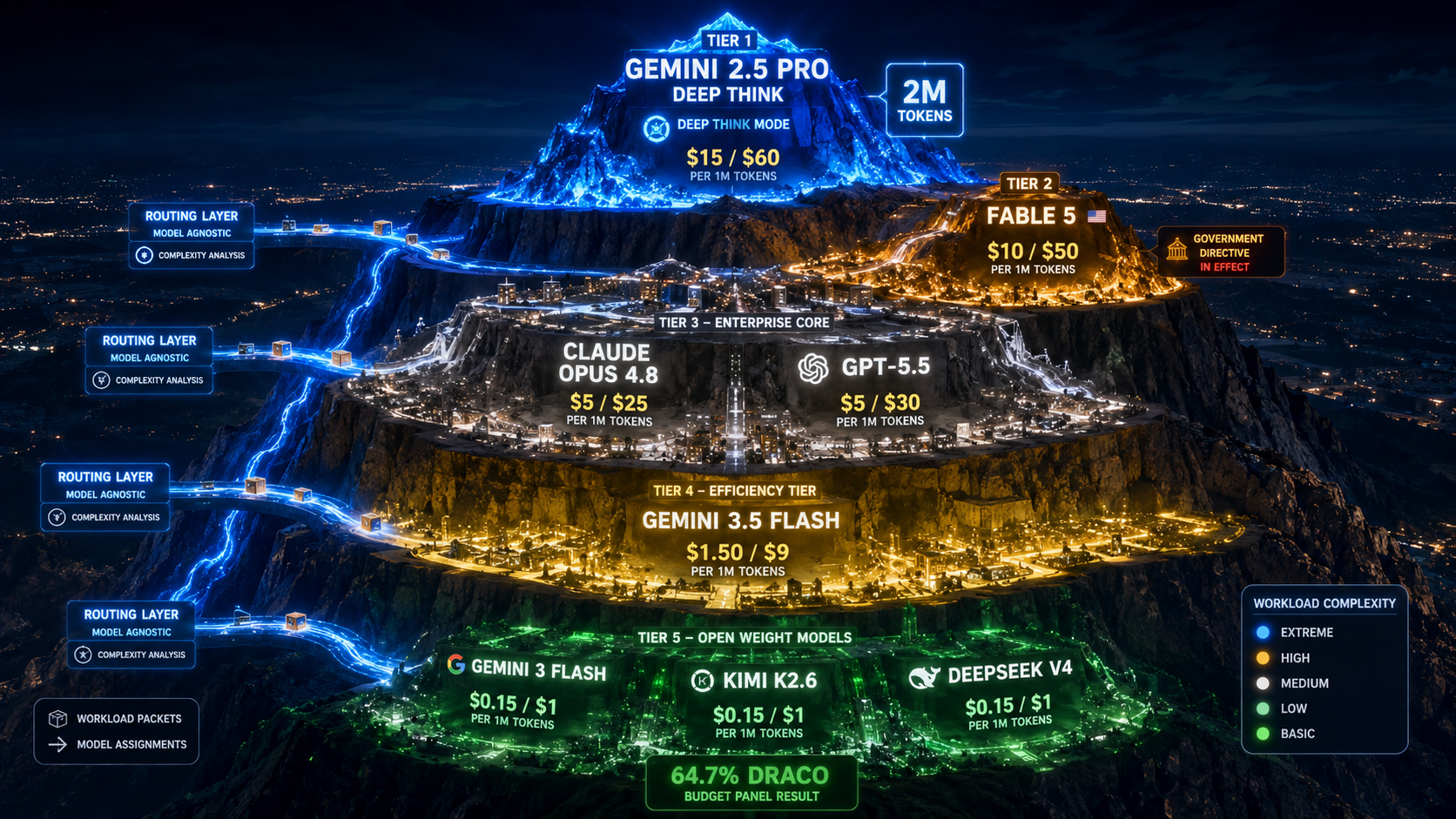
The Frontier Model Market Just Restructured Overnight: What Gemini 2.5 Pro Deep Think, Fable 5's Billing Cliff and the OpenRouter Fusion Data Mean for Every Enterprise AI Architecture

Apple's Last Act and Its Biggest AI Bet: What WWDC 2026, Siri AI and iOS 27 Mean for Every Enterprise in Apple's Ecosystem

The Most Capable Model Ever Released and a $965 Billion Valuation: What Claude Opus 4.8 and Anthropic's $65B Raise Mean for Every Enterprise Building on AI
CONTACT
LET'S ENGINEER THE FUTURE — TOGETHER
.png)
.
.
/
.png)
Whether you're scaling a digital product, modernizing operations, or building from the ground up — Legacies Techno is your partner in crafting intelligent, enterprise-grade solutions that create lasting impact.
GET IN TOUCHGET IN TOUCH